Castling and en passant
The two special moves, and when they are allowed.

The idea
Two special moves: the king castles, and a pawn can take in passing.
- An enemy pawn jumps two squares and lands right beside yours.
- You may take it as if it had moved one square, but only at once.
- In castling, the king moves two squares towards a rook, which jumps over it.
In a game: If an enemy pawn jumps two squares to land beside yours, decide at once: take it or not.
The lesson
Castling is the one move where two pieces move at once. The king goes two squares towards a rook, and the rook jumps to the other side of the king. It makes the king safer and brings the rook into play.
Here White castles on the kingside, the side of the board with the h-file, written O-O, and Black on the queenside, the side with the a-file, written O-O-O.

- 1. O-O White’s king goes from e1 to g1 and the rook jumps from h1 to f1.
- 1... O-O-O Black’s king goes from e8 to c8 and the rook from a8 to d8.

A question
White has not moved the king or the h1 rook. Can White castle kingside here?

Show the answer
No, the king would pass through f1, which the rook attacks.
Right. A king may not castle out of check, into check or through an attacked square.
Find the move
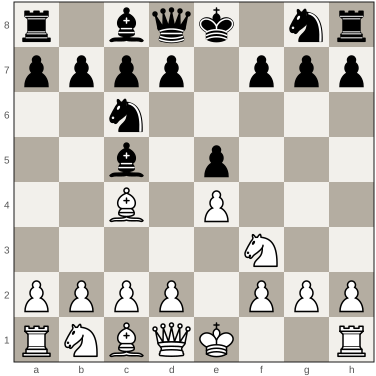
It is White’s move, and the squares between the king and the h1 rook are empty. Castle kingside.
A hint
Move the king two squares towards the rook.
Show the answer
4. O-O
The king went to g1 and the rook to f1. Castling early is a good habit: it keeps the king safe and the rook active.
The last special move is en passant, French for “in passing”. When a pawn moves two squares from its start and lands beside an enemy pawn, that pawn may capture it as if it had moved only one square.
It must be done at once, on the very next move, or the right is gone.

- 2. exd6 The white pawn captures the pawn on d5 and lands on d6, behind it. The black pawn is removed.

Find the move
Black has just moved the pawn from d7 to d5, next to your pawn. Capture it en passant.
A hint
Capture diagonally to d6, the square the black pawn jumped over.
Show the answer
2. exd6
You took the pawn as if it had stopped on d6. The right lasts for one move only.
A question
When can a pawn capture en passant?
Show the answer
Only on the very next move after an enemy pawn moves two squares to land beside it.
Right. If you wait a move, the chance is gone.