Chess lessons
Chess basics
How the pieces move, and what check, checkmate and stalemate mean. 9 lessons, 7 of them free.

Beginner · 5 min · Free
Every square has a name, and every piece has a square to start on.
- Turn the board so each player has a light square in the right-hand corner.
- The rooks go in the corners, then the knights, then the bishops.
- The queen goes on her own colour, and the king stands beside her.
In a game: Before you play, check the light square is on your right and each queen is on her colour.
Read the lesson
Beginner · 6 min · Free
The rook moves in straight lines, and the bishop along diagonals.
- The rook moves along its rank or file, as far as the way is clear.
- A piece in its way stops it, but it may take an enemy piece.
- A bishop moves the same way along diagonals, so it keeps to one colour.
In a game: Look along open lines: a rook or a bishop far away can still attack.
Read the lesson
Beginner · 5 min · Free
The queen moves any distance in a line; the king moves one square.
- The queen moves along ranks, files and diagonals, as far as she likes.
- She captures the way she moves, here the pawn on her diagonal.
- The king moves just one square, but in any direction.
In a game: Before your king moves, check that no enemy piece attacks the square.
Read the lesson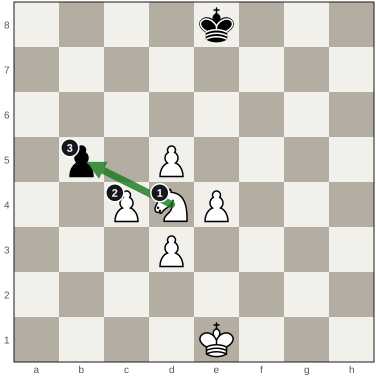
Beginner · 5 min · Free
The knight jumps in an L, and it is the only piece that can jump.
- The knight moves in an L: two squares one way, then one to the side.
- Its own pawns stand on all four sides, but a knight jumps over pieces.
- So it can still land on the black pawn and take it.
In a game: A knight cannot be blocked, so count its jumps even in a crowded position.
Read the lesson
Beginner · 6 min · Free
A pawn moves forward, captures diagonally, and can become a queen.
- The pawn moves straight forward: one square, or two on its first move.
- It captures one square diagonally forward, never straight ahead.
- If it reaches the far end, it is promoted, nearly always to a queen.
In a game: Watch every pawn that gets close to the far end: it can become a queen.
Read the lesson
Beginner · 7 min · Free
Two special moves: the king castles, and a pawn can take in passing.
- An enemy pawn jumps two squares and lands right beside yours.
- You may take it as if it had moved one square, but only at once.
- In castling, the king moves two squares towards a rook, which jumps over it.
In a game: If an enemy pawn jumps two squares to land beside yours, decide at once: take it or not.
Read the lesson
Beginner · 8 min · Free
A king in check must escape at once; if it cannot, it is checkmate.
- The rook goes to the back rank and gives check.
- The king cannot step away: its pawns block it and the rook covers the rest.
- Nothing can block the check or take the rook, so it is checkmate.
In a game: When you are winning, check your opponent still has a move: no move and no check is a draw.
Read the lesson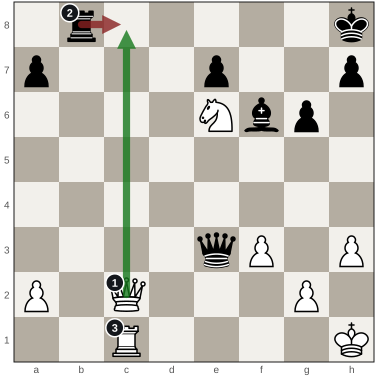
Beginner · 6 min · Pro
Points tell you if a trade is good, but a checkmate beats them all.
- The queen, worth the most, gives check on the back rank.
- The rook must take her, so White is behind on points.
- But this rook takes back with checkmate, and mate ends the game.
In a game: Before you trade, count the points you give and the points you get.
Read the lesson
Beginner · 6 min · Pro
Every move has a short written code, so you can follow any game.
- A pawn move is written as just the square it goes to.
- Other pieces put a capital letter first, such as N for the knight.
- An x means a capture, + means check and # means checkmate.
In a game: Write your moves down as you play, and you can go over the game later.
Read the lesson