Chess lessons
Chess openings
How to start a game, and the openings players choose most. 13 lessons, 3 of them free.
Beginner · 7 min · Free
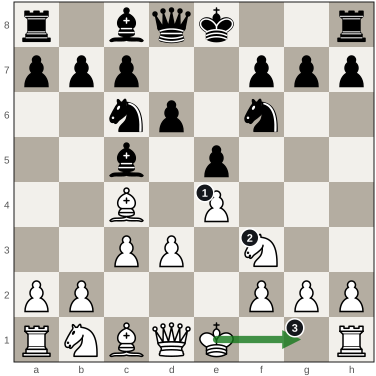
Fight for the centre, develop your pieces, and castle.
- The pawn on e4 takes a share of the centre.
- The knight and bishop are off the back rank: they are developed.
- Now castle: the king goes to safety and the rook leaves the corner.
In a game: In your first moves, ask if each move helps the centre, develops a piece or castles.
Read the lesson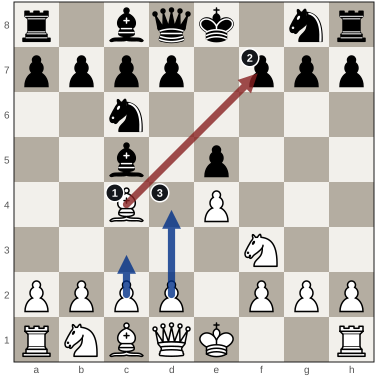
Beginner · 8 min · Free
Both sides develop fast, and White’s bishop aims at the weak f7.
- The bishop on c4 aims at f7.
- Only the black king guards f7, so it is a weak spot.
- White’s plan is c3 and then d4, for a big pawn centre.
In a game: A good first choice after e4 e5; when you face it as Black, watch f7.
Read the lesson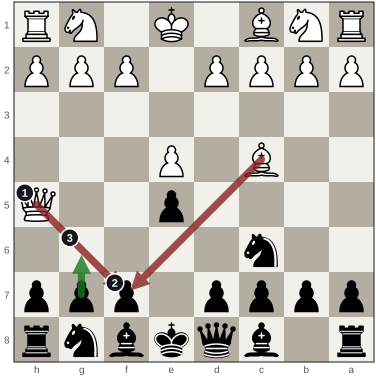
Beginner · 10 min · Free
A trick that wins material, or the game, from a player who misses it.
- White’s queen and bishop both aim at f7.
- Only the king guards f7, so the queen could take it with checkmate.
- Stop it: g6 attacks the queen and blocks her path to f7.
In a game: When your opponent offers something for free, stop and look for the catch.
Read the lesson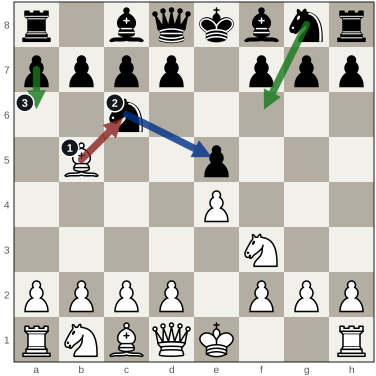
Intermediate · 12 min · Pro
White’s bishop attacks the knight that guards the pawn on e5.
- The bishop attacks the knight on c6.
- That knight is the only guard of the pawn on e5.
- Black can answer with a6, the Morphy, or Nf6, the Berlin.
In a game: Taking on c6 does not simply win the pawn on e5: Black can win it back.
Read the lesson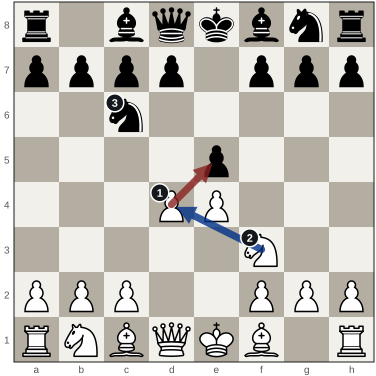
Intermediate · 11 min · Pro
The Scotch opens the centre at once; the Four Knights keeps it simple.
- White’s pawn on d4 attacks e5 at once.
- If Black takes it, the knight takes back on d4.
- There the knight stands in the centre and attacks c6.
In a game: Take back on d4 with the knight, never the queen: the knight on c6 attacks d4.
Read the lesson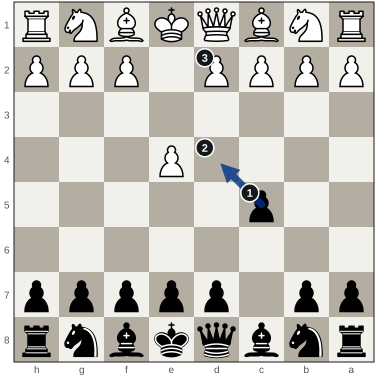
Intermediate · 11 min · Pro
Black answers e4 with c5 and fights for d4 from the side.
- Black answers e4 with the c-pawn, not the e-pawn.
- It attacks d4, so White cannot easily build a pawn centre.
- In the main line the pawns trade on d4, and each side gets a half-open file.
In a game: A good answer to e4 when you want an unbalanced game, not a copy of White’s moves.
Read the lesson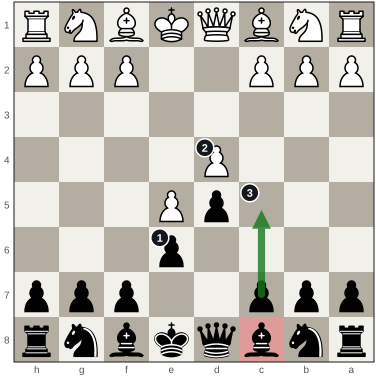
Intermediate · 10 min · Pro
Black meets e4 with e6 and d5, building a solid pawn chain.
- Black’s pawns on e6 and d5 make a chain: e6 guards d5.
- White’s chain runs from d4 to e5, and d4 is its base.
- Black attacks the base with c5: without d4, e5 loses its support.
In a game: Solid against e4, but have a plan for the bishop on c8 that your own pawns shut in.
Read the lesson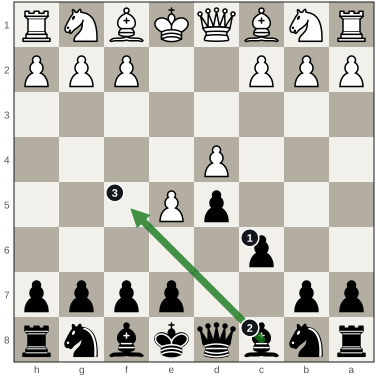
Intermediate · 10 min · Pro
Black supports d5 with c6 and brings the bishop out before e6.
- The pawn on c6 supports the pawn on d5.
- Black has not played e6, so the bishop on c8 is free.
- It comes out to f5 before e6 can shut it in.
In a game: A solid answer to e4 for players who want a pawn on d5 without a shut-in bishop.
Read the lesson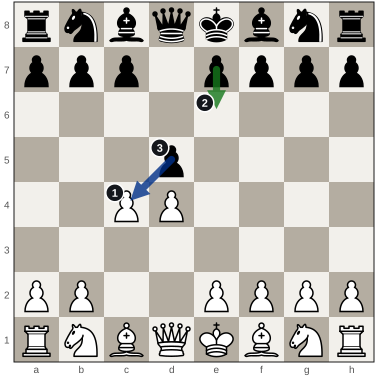
Intermediate · 11 min · Pro
White attacks Black’s centre pawn on d5 with a pawn from the side.
- White’s pawn on c4 attacks d5, and nothing defends it.
- Black can keep d5 with e6: the Queen’s Gambit Declined.
- Or Black takes on c4, and White can usually win the pawn back.
In a game: Declining with e6 is solid, but it shuts in the bishop on c8, as in the French.
Read the lesson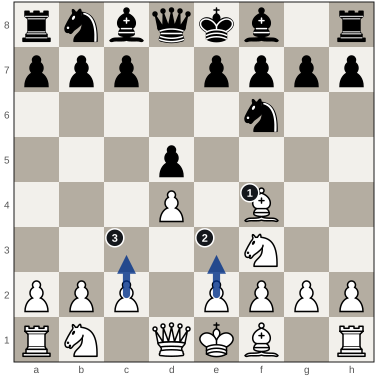
Intermediate · 10 min · Pro
One set-up that White can play against almost anything.
- The bishop comes out to f4 before e3 can shut it in.
- Then e3 supports d4, and the bishop is not blocked.
- Next come c3, Nbd2, Bd3 and castling, and the set-up is done.
In a game: Good if you want one plan with White; after Bf4, watch for Qb6 attacking b2.
Read the lesson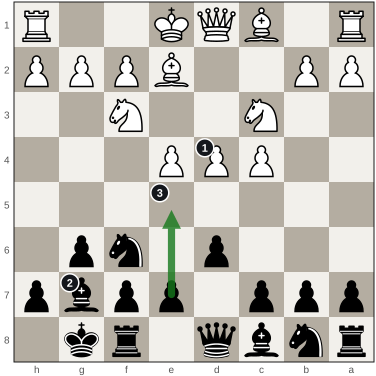
Intermediate · 11 min · Pro
Black lets White build a big centre, then attacks it with e5 and f5.
- White has built a big pawn centre on c4, d4 and e4.
- Black’s bishop sits on the long diagonal and guards the king.
- Now Black strikes at the centre with e5, attacking d4.
In a game: If White closes the centre with d5, attack on the kingside with f5.
Read the lesson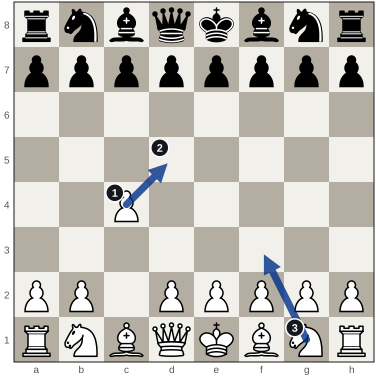
Intermediate · 10 min · Pro
Fight for the centre from the side, and decide the rest later.
- White starts with the c-pawn: a flank opening.
- From the side, it controls the centre square d5.
- The Réti has the same idea, with the knight going to f3 first.
In a game: A flexible start; watch for transpositions into openings you know, like the Queen’s Gambit.
Read the lesson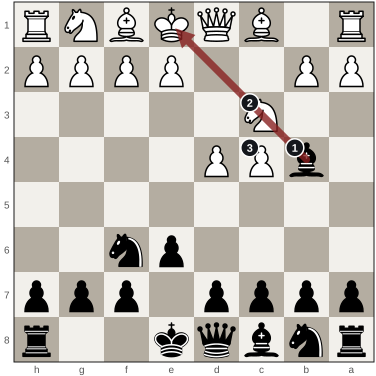
Intermediate · 12 min · Pro
Two solid answers to d4: c6 keeps the bishop free, Bb4 pins a knight.
- The bishop pins the knight on c3 to the white king.
- Black can take it and make White take back with the b-pawn.
- That leaves White with doubled pawns on c3 and c4.
In a game: Against d4 and c4, pin a knight on c3 with Bb4, or keep your bishop free with c6.
Read the lesson