Chess lessons › Chess openings
The Slav and the Nimzo-Indian
Two solid answers to 1.d4: one keeps the bishop free, the other pins a knight to damage the pawns.
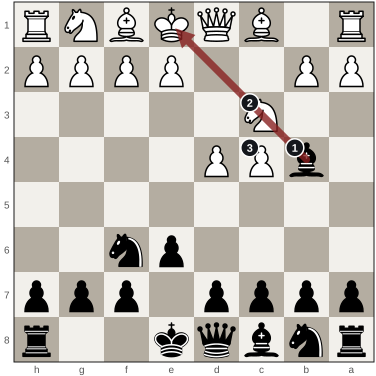
The idea
Two solid answers to d4: c6 keeps the bishop free, Bb4 pins a knight.
- The bishop pins the knight on c3 to the white king.
- Black can take it and make White take back with the b-pawn.
- That leaves White with doubled pawns on c3 and c4.
In a game: Against d4 and c4, pin a knight on c3 with Bb4, or keep your bishop free with c6.
How the lesson begins
Find the move
Black to move. White has played 1.d4 Nf6 2.c4 e6 3.Nc3. Develop the king’s bishop to the square where it pins the knight to the king.
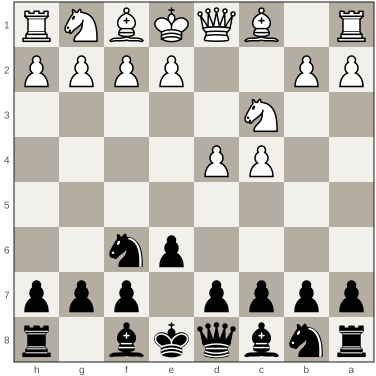
A hint
The bishop on f8 goes to b4.
Show the answer
3... Bb4
Bb4 is the Nimzo-Indian Defence. The knight on c3 cannot move, because the bishop would then attack the king: it is pinned. Among players rated 1200 to 1599 on Lichess, White scored 47% after 1.d4 Nf6 2.c4 e6 3.Nc3 Bb4, so Black holds its own with this set-up.
A question
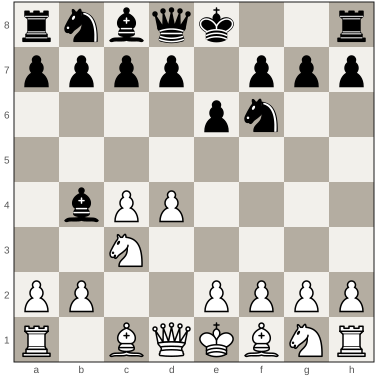
Black’s bishop pins the knight on c3. What is the point of the pin?
Show the answer
Black can take the knight and force White to recapture with the b-pawn, which doubles White’s c-pawns.
Right. That is Black’s main idea: give up the bishop to damage White’s pawn structure.
In numbers
How often it is played
| Rating | Value |
|---|---|
| Under 800 | Too few games |
| 800 to 1199 | Too few games |
| 1200 to 1599 | 0.3 |
| 1600 to 1999 | 1.8 |
| 2000 and up | 5.4 |
How the games ended
White won 49%, 6% were drawn and Black won 45%, over 2,644 games that start this way, in a sample of rated Lichess games from 2026.