Chess lessons
Checkmate patterns
The patterns that end games, and the basic mates with a lone king. 10 lessons, 4 of them free.

Beginner · 6 min · Free
A rook or queen mates a king shut in by its own pawns.
- The king’s own pawns block the squares in front of it.
- The rook checks along the back rank.
- It covers the squares beside the king, and nothing can block: mate.
In a game: Look for a castled king behind unmoved pawns, with no piece guarding its back rank.
Read the lesson
Beginner · 8 min · Free
Mate a lone king with your queen and king, and avoid stalemate.
- Your king comes close, because the queen cannot mate alone.
- A queen move here gives no check and leaves no move: stalemate.
- Instead the queen checks next to the king, guarded by yours: mate.
In a game: Against a lone king, make sure it still has a move until the move that mates.
Read the lesson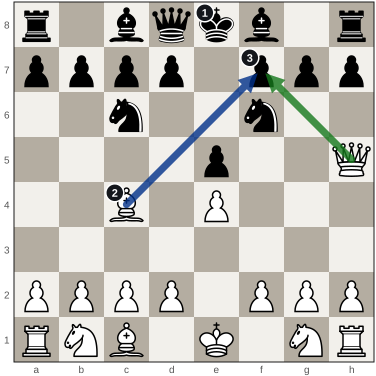
Beginner · 7 min · Free
Test every check: no escape, no capture and no block means mate.
- The king cannot move: its own pieces and the queen take its squares.
- The queen cannot be taken, because the bishop protects her.
- Nothing can block a check from the next square, so it is mate.
In a game: Before every move, list the checks you can give and test each one.
Read the lesson
Beginner · 6 min · Free
The rooks take turns to check, pushing a lone king to the edge.
- One rook holds the seventh rank, so the king cannot step back.
- The other rook checks along the back rank.
- The king has run out of ranks: it is mate.
In a game: With both rooks against a lone king, check with one while the other holds the rank behind.
Read the lesson
Intermediate · 8 min · Pro
The knight takes the king’s squares, and the rook gives the check.
- The knight takes away the marked squares next to the king.
- The king’s own pawn blocks another square.
- The rook checks along the edge, and the king has nowhere to go.
In a game: Look for a king on the edge, your knight close by, and a rook that can reach its file.
Read the lesson
Intermediate · 7 min · Pro
A knight mates a king whose own pieces take away every square.
- The king sits in the corner, boxed in by its own rook and pawns.
- The knight jumps in and gives check.
- Nothing can take the knight or block its check, so it is mate.
In a game: Look for a king in the corner boxed in by its own pieces, and a knight that can check it.
Read the lesson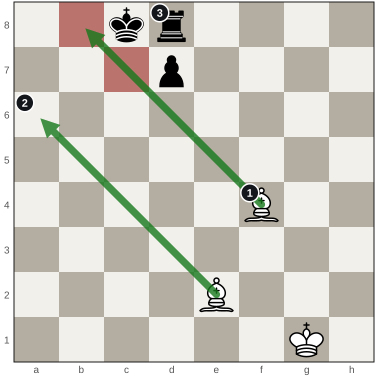
Intermediate · 7 min · Pro
Bishops on crossing diagonals mate a king hemmed in by its own pieces.
- One bishop takes away the marked squares beside the king.
- The other bishop checks along the other diagonal.
- The king’s own rook and pawn fill the last squares: mate.
In a game: Look for a king boxed in by its own pieces, with open diagonals crossing beside it.
Read the lesson
Intermediate · 7 min · Pro
A queen mates a king whose own pieces block the squares beside it.
- The king’s own rooks stand on both sides of it.
- The queen checks from the front, down the file.
- She covers the squares in front of the king, so it is mate.
In a game: Look for a king with its own pieces on both sides and nothing guarding the squares in front.
Read the lesson
Intermediate · 8 min · Pro
Start with checks: they leave the other side the fewest replies.
- Start with a check: the king has no square and nothing can block.
- So Black’s only move is to take the rook.
- The other rook takes back with check, and it is mate.
In a game: Before you move, list your checks and count the replies each one leaves.
Read the lesson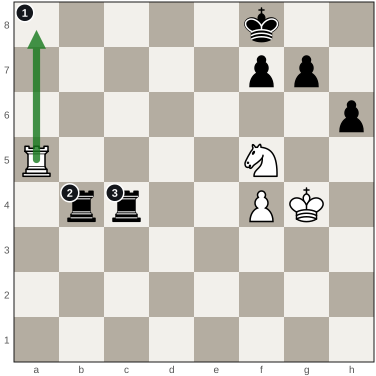
Intermediate · 8 min · Pro
Find a forcing move, see the reply, and ask again until it is mate.
- Start with a check: the king cannot move, so Black must block.
- A rook blocks, and you take it with check.
- The other rook blocks too; take it, and it is mate.
In a game: Do not hunt for the end at once: play a check, see the reply, and look again.
Read the lesson