Reading chess notation
How moves are written, so you can follow a book or a game.

The idea
Every move has a short written code, so you can follow any game.
- A pawn move is written as just the square it goes to.
- Other pieces put a capital letter first, such as N for the knight.
- An x means a capture, + means check and # means checkmate.
In a game: Write your moves down as you play, and you can go over the game later.
How the lesson begins
Every move can be written down in a short code called notation. A pawn move is just the square it goes to: e4. For any other piece the letter comes first: N for knight, B for bishop, R for rook, Q for queen and K for king. So Nf3 means a knight goes to f3.

- 1. e4 A pawn to e4.
- 1... e5 2. Nf3 A knight to f3.
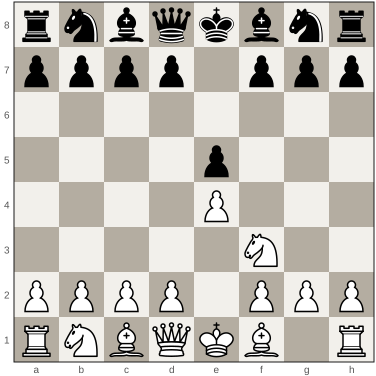
More signs: x means a capture, + means check, # means checkmate, and castling is O-O on the kingside and O-O-O on the queenside. When a pawn captures, the file it leaves comes first: dxc6 is the d-pawn taking on c6.
- 2... Nc6 3. Bb5 A bishop to b5.
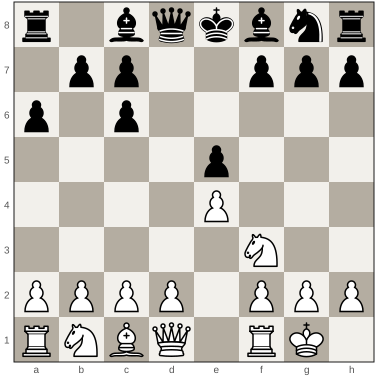
- 3... a6 4. Bxc6 An x means a capture. The bishop takes the knight on c6.
- 4... dxc6 5. O-O White castles kingside.
A question
What does Qxd8+ mean?
Show the answer
A queen takes a piece on d8 and gives check.
Right. Q is the queen, x means takes, d8 is the square and + means check.