Chess lessons › Famous chess games
The Evergreen Game
Anderssen’s second masterpiece: a quiet rook move, then three sacrifices.
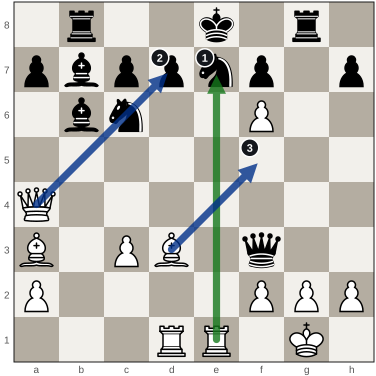
The idea
Anderssen ignores a threat of mate, because his own mate comes first.
- A rook takes the knight with check, and Black takes back.
- Next the queen is given up with check, and the king takes her.
- The bishop’s check uncovers the rook behind it: double check, then mate.
In a game: When your opponent threatens mate, look first for checks that mate sooner.
How the lesson begins
Adolf Anderssen played this game against Jean Dufresne, probably in Berlin, in 1852. Years later the first world champion, Wilhelm Steinitz, called it the Evergreen Game, because it never gets old. It starts as an Evans Gambit and ends with a chain of sacrifices.

The game starts as an Evans Gambit, a favourite attacking line of the time. After 4.b4 Bxb4 White has given up a pawn and will play for the centre and open lines against the black king.
- 1. e4 e5 2. Nf3 Nc6 3. Bc4 Bc5 4. b4 The b-pawn is offered to pull Black’s bishop away.
- 4... Bxb4
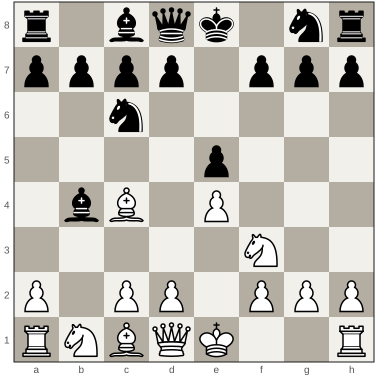
White takes the centre with c3 and d4 and castles. Black’s pawn goes to d3, which cramps White, but Anderssen keeps attacking: 8.Qb3 backs up the attack on f7 and hits b7, and 9.e5 drives Black’s queen to g6. Re1 and Ba3 bring more pieces to the attack.
- 5. c3 Ba5 6. d4 White takes the centre.
- 6... exd4 7. O-O White castles.
- 7... d3 The pawn on d3 cramps White.
- 8. Qb3 The queen backs up the attack on f7 and attacks b7.
- 8... Qf6 9. e5 The pawn attacks the queen.
- 9... Qg6 10. Re1 The rook joins the e-file.
- 10... Nge7 11. Ba3 The bishop looks at e7 and f8.
- 11... b5
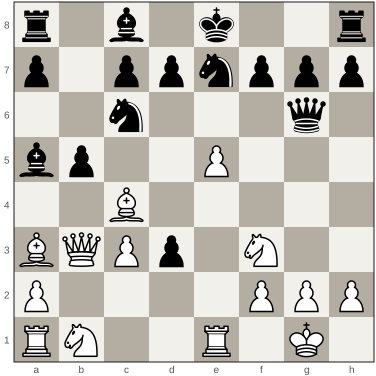
The queen takes on b5 and attacks the bishop on a5, and Black’s rook attacks the queen. The queen retreats to a4, and White develops his last knight to d2 and e4. After 16.Bxd3 the pawn on d3 is gone, and Black’s queen goes after White’s knights.
- 12. Qxb5 The queen takes a pawn and attacks the bishop.
- 12... Rb8 13. Qa4 The queen retreats and keeps watching c6.
- 13... Bb6 14. Nbd2 The last knight is developed.
- 14... Bb7 15. Ne4 The knight lands on e4.
- 15... Qf5 16. Bxd3 The bishop takes the pawn on d3.
- 16... Qh5 Black’s queen attacks the knight on f3.
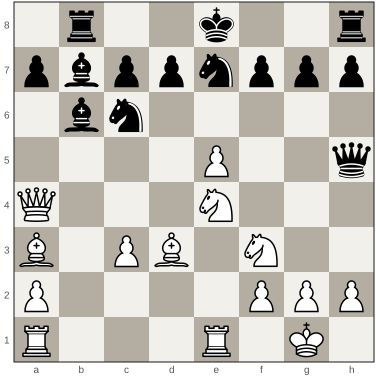
Now the fireworks begin. 17.Nf6+ is a knight check offered as a sacrifice. Black takes it with the pawn, which opens the g-file.
- 17. Nf6+ A knight check, offered as a sacrifice.
- 17... gxf6 Black takes with the pawn, and the g-file opens.
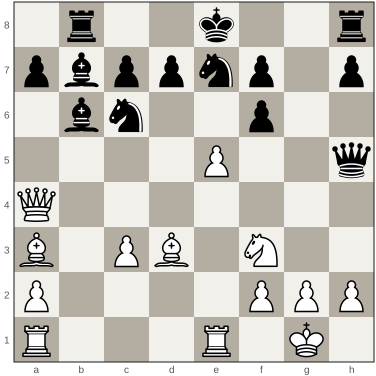
Find the move
Black has taken the knight with the pawn. Take back, so that your pawn attacks the knight on e7.
A hint
The pawn on e5 takes on f6.
Show the answer
18. exf6
exf6 recaptures and attacks the knight on e7. White has given a knight, but the attack goes on.