Chess lessons › Famous chess games
The Opera Game
Morphy’s famous win, played at the opera house in Paris in 1858.
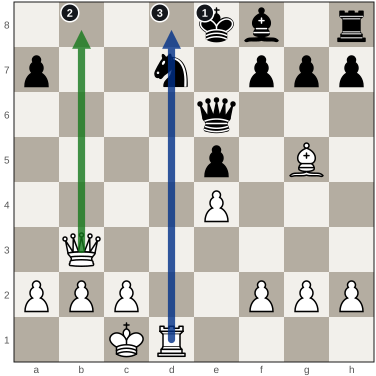
The idea
Morphy brings out his pieces fast and mates a king left in the middle.
- Black’s king is still in the middle, and his rook and bishop never moved.
- The queen gives check and is given up: the knight has to take her.
- Then the rook mates, guarded by the bishop: the opera mate.
In a game: When the enemy king is stuck in the middle, open lines and attack it with every piece.
The lesson
In 1858 the American Paul Morphy sat down at the opera house in Paris and played White against two opponents, the Duke of Brunswick and Count Isouard, who talked over each move together. It is one of the most famous games ever played, because it shows what to do in the opening: bring out pieces quickly, fight for the centre, and attack while the other king is in the middle.
Play through it, one stage at a time.

Morphy, with White, plays the king’s pawn and brings out a knight. His opponents, who talk over each move together, answer with the Philidor Defence, 2...d6. After 3.d4 they pin the knight with 3...Bg4. A pin keeps a piece from moving safely, because a more valuable piece stands behind it.
- 1. e4 e5 2. Nf3 d6 3. d4 White takes a share of the centre at once.
- 3... Bg4 The bishop pins the knight on f3 to the queen.
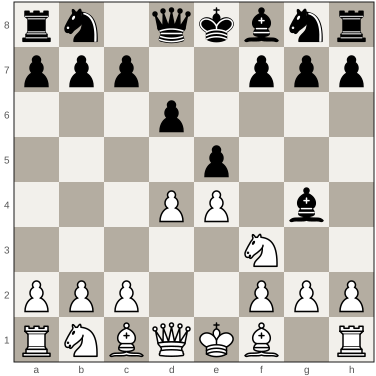
Morphy opens the centre with 4.dxe5. Black takes the knight on f3, the queen takes back, and Black takes the pawn on e5. The d-file is now open, which will matter at the end of the game.
- 4. dxe5 White takes the pawn on e5. The pawns will be traded, and that opens the centre.
- 4... Bxf3 Black takes the knight, which ends the pin.
- 5. Qxf3 The queen takes back and now looks at f7.
- 5... dxe5 The d-file is open.
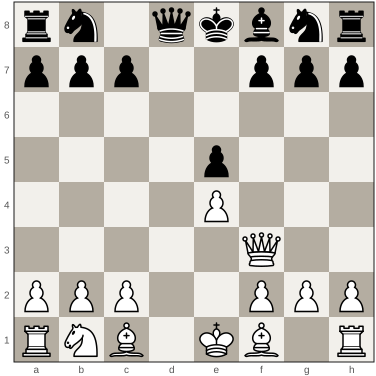
6.Bc4 attacks f7 a second time, and Black’s knight on f6 blocks the queen’s file. Morphy backs up the bishop with 7.Qb3, which supports the attack on f7 and attacks the pawn on b7 as well. Black defends f7 with the queen and leaves b7 hanging.
- 6. Bc4 A second attacker aims at f7.
- 6... Nf6 The knight blocks the queen’s attack on f7.
- 7. Qb3 The queen backs up the bishop and attacks b7 as well.
- 7... Qe7 The queen defends f7, but the pawn on b7 is left hanging.
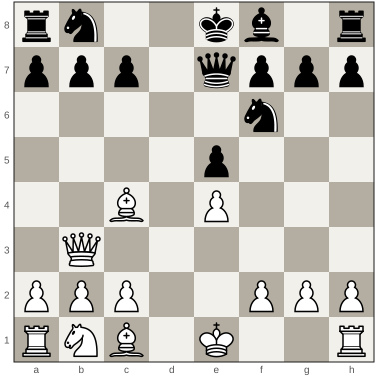
Morphy does not take on b7, which would let Black trade queens. He brings out another piece, and 9.Bg5 pins the knight on f6 to the queen. Then Black plays 9...b5, which attacks the bishop on c4.
- 8. Nc3 Another piece joins the game, instead of a pawn grab.
- 8... c6 Black prepares to play ...b5.
- 9. Bg5 The knight on f6 is pinned to the queen.
- 9... b5 The pawn attacks the bishop on c4.
Find the move
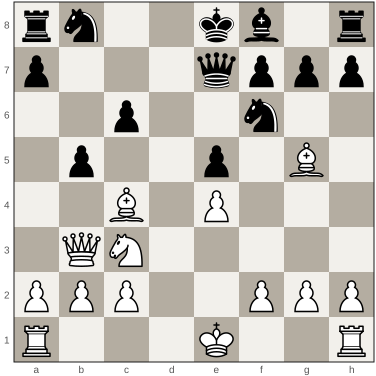
Black has just played b5, attacking your bishop. Morphy’s reply is famous. Find the knight sacrifice that keeps the attack going.
A hint
Take the pawn on b5 with the knight, not the bishop.
Show the answer
10. Nxb5
Nxb5! gives up a knight to open lines against a king that is still in the middle. After ...cxb5 the bishop takes on b5 with check.
Morphy leaves the bishop and gives up a knight: 10.Nxb5! After 10...cxb5 11.Bxb5+ Black blocks with a knight. Morphy castles, which attacks that knight with a rook, and Black defends it with a rook.
- 10. Nxb5 A knight is given up to open lines against the king.
- 10... cxb5 11. Bxb5+ Check. Black blocks with a knight.
- 11... Nbd7 12. O-O-O Castling brings a rook to the d-file with a threat.
- 12... Rd8 The rook defends the knight.
Find the move
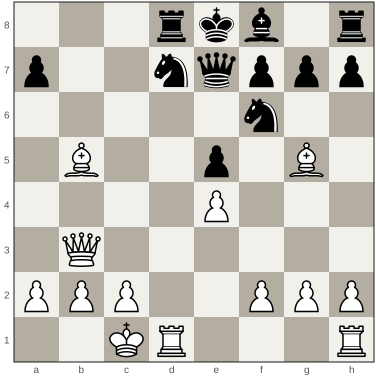
Black’s rook defends the knight on d7. Give up a rook for that knight, so that Black’s rook has to take on d7. Find it.
A hint
Take the knight on d7 with the rook.
Show the answer
13. Rxd7
Rxd7! trades a rook for a knight. After ...Rxd7 the bishop on b5 pins that rook, and the second rook comes to d1.
13.Rxd7! drags that rook onto d7, where the bishop on b5 pins it. The second rook comes to d1, and Black’s queen can only defend. The bishop then takes the rook with check, and the knight takes back.
- 13. Rxd7 A rook is given up for a knight, to pull Black’s rook onto d7.
- 13... Rxd7 14. Rd1 The second rook joins in. The rook on d7 is pinned by the bishop on b5.
- 14... Qe6 The queen defends the pinned rook.
- 15. Bxd7+ The bishop takes the rook with check.
- 15... Nxd7 The knight takes back.
Find the move
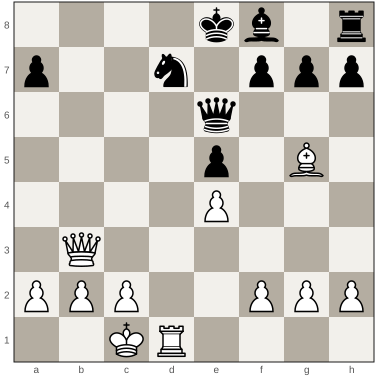
Black has just taken the bishop with the knight. White now has a forced checkmate in two. Find it.
A hint
The b-file is open. Which piece can use it with check?
Show the answer
16. Qb8+ Nxb8 17. Rd8#
Qb8+!! gives up the queen. Black must take it, and then Rd8 is checkmate. The bishop on g5 protects the rook and covers e7, the rook covers d7, and Black’s own bishop and pawn fill f8 and f7. Checkmate with a rook protected by a bishop is called the opera mate.
A question
What did Morphy do right in this game?
Show the answer
He kept developing pieces and attacked a king that was still in the middle.
Right. Black spent moves on pawns and trades, and when his king needed help most of his pieces were still at home.