How a game is drawn
Stalemate, agreement, repetition, the fifty-move rule and too little material to mate.

The idea
Stalemate, agreement, repetition, fifty moves, or too little material.
- White has only two pawns for a rook, so a draw is a good result.
- Qe8+ leaves the king only h7, and Qh5+ sends it back to g8.
- When the same position comes up three times, a draw can be claimed.
In a game: When you are losing, look for checks that never end; when winning, avoid repeating moves.
The lesson
Not every game has a winner. In a draw nobody wins, and each player gets half a point. There are five main ways a game is drawn.
You have met the first already: stalemate. The player to move is not in check but has no legal move. Here the black king cannot take the pawn on a7, which the white king protects, and b7 and b8 are attacked. Black has no move, so the game is drawn.

A question
The second way is the simplest: the players agree to a draw. One player offers a draw, and if the other accepts, the game is over. What happens if the other player says no, or simply makes a move?
Show the answer
The game goes on.
Right. A draw offer is turned down by saying so or just by playing a move. Then the game continues as normal.
Find the move
The third way is repetition. White has only two pawns for a rook here, so a draw would be a fine result. Find a check that starts a run of checks Black cannot escape.

A hint
The queen can reach the back rank along the e-file.
Show the answer
1. Qe8+
Qe8+ leaves the black king just one move, to h7. Then Qh5+ sends it back to g8, and Qe8+ comes again. Giving check for ever like this is called perpetual check.
A question
After Qe8+ Kh7 Qh5+ it is Black’s move. Is there a way out of the checks?

Show the answer
No. Kg8 is the only move, and then Qe8+ comes again.
Right. Black can only go back and forth, and White can check for ever.
When the same position comes up three times, with the same player to move, a player can claim a draw by threefold repetition. The three times do not have to come one after another.
Step through the checks. The position after Qe8+ appears for the third time on the last move.
- 1. Qe8+ The first time this position appears.
- 1... Kh7 2. Qh5+ Kg8 3. Qe8+ The same position for the second time.
- 3... Kh7 4. Qh5+ Kg8 5. Qe8+ The third time. The game can be claimed as a draw.

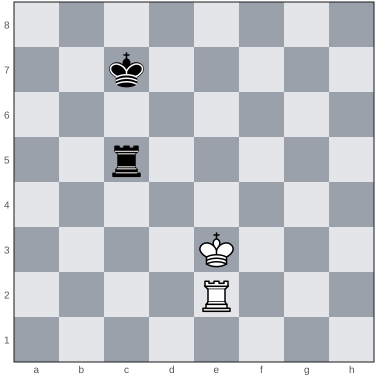
The fourth way is the fifty-move rule. If each player has made fifty moves in a row with no capture and no pawn move, a player can claim a draw. It stops a game from going on for ever when neither side gets anywhere.
In this rook ending, Black’s last fifty moves and White’s last forty-nine had no capture and no pawn move. White’s next move makes it fifty each.

- 120. Re2 Fifty moves each with no capture and no pawn move: a draw can be claimed.
The fifth way is insufficient material: too few pieces are left for anyone to give checkmate. King against king is a draw at once, because a king can never give check.
The same is true of a king and a bishop against a king, and of a king and a knight against a king. No checkmate is possible, however the game goes on.

A question
White has a king and a knight, Black only a king. Is this a draw?

Show the answer
Yes. A king and a knight can never mate a lone king.
Right. There is too little material to give checkmate, so the game is drawn as it stands.
A question
And here? White has a king and a rook against a king.

Show the answer
Not a draw: White wins with correct play.
Right. A rook is enough to force mate. Of the single pieces, only a bishop or a knight is too little.
Find the move
Black to move. Black is a bishop and a pawn behind. Find the move that makes the game a draw at once.

A hint
What can your king capture?
Show the answer
1... Kxd2
Kxd2 takes the last white pawn. White is left with a king and a bishop, which can never give checkmate, so the game is drawn.