Chess lessons › Checkmate patterns
Epaulette, dovetail and swallow’s tail
Three mates where the king’s own pieces block its way out, and how to tell them apart.
The idea
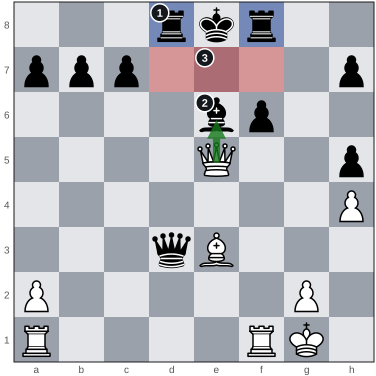
The king’s own pieces fill its squares, and the queen covers the rest.
- Black’s own rooks fill d8 and f8, on both sides of the king.
- The queen takes on e6, two squares in front of the king, with check.
- From e6 she covers d7, e7 and f7: mate.
In a game: When the king’s own pieces stand beside it, look for a queen check that covers the rest.
How the lesson begins
Some mates need help from the side that loses. The king’s own pieces stand on the squares it would run to, and the attacker only has to cover the rest. This lesson shows three such mates.
The first is the epaulette mate. Here Black’s rooks on d8 and f8 stand on both sides of the king, like the epaulettes on a uniform.
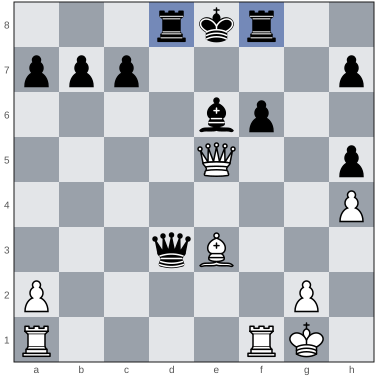
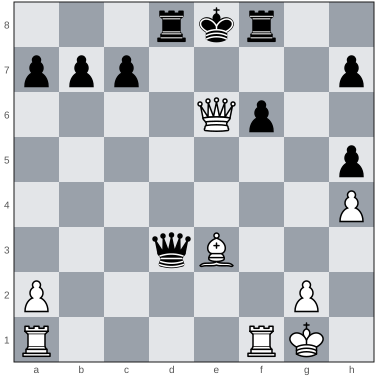
- 24. Qxe6# The queen takes the bishop with check, two squares in front of the king. From e6 she covers d7, e7 and f7, and the rooks fill d8 and f8.
Find the move
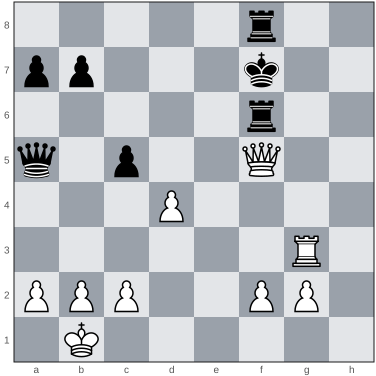
The epaulettes can also stand above and below the king. This is from a game Magnus Carlsen won at Wijk aan Zee in 2004, when he was 13. Black has just blocked a check with the rook on f6. White to move: find the mate.
A hint
Black’s rooks already fill f8 and f6. Which check covers the three squares on the e-file?
Show the answer
29. Qd7#
Qd7#. The queen checks along the seventh rank from two squares away and covers e8, e7 and e6. The rook on g3 holds g8, g7 and g6, and Black’s own rooks fill f8 and f6.
In numbers
In the puzzle bank
707 puzzles in GreyChess’s bank practise it. Half of them are rated between 929 and 2,021.
The piece that makes the first move of the answer: rook 48%, queen 31%, knight 8%, pawn 7%, bishop 6%, in puzzles from the Lichess puzzle database.