Chess lessons › Chess endgames
Bishop and pawn against bishop
With bishops of one colour, a king in front of the pawn on the other colour draws; a cut-off king must race.
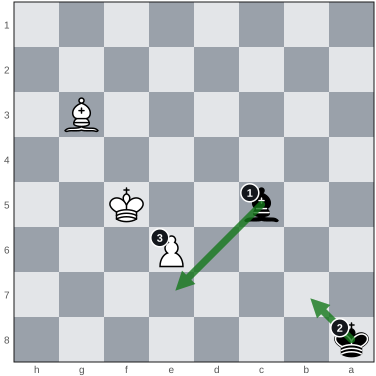
The idea
The king in front draws; a cut-off king must race to the pawn.
- Black’s bishop on c5 guards e7, the pawn’s next square.
- The cut-off king must run to the pawn: Kb7 is the only move.
- White’s pawn on e6 cannot be stopped by the bishop alone.
In a game: A cut-off king with a bishop against a pawn: count whether the king reaches the pawn in time.
How the lesson begins
White has a bishop and a pawn against a bishop, and both bishops run on dark squares: they are of the same colour. Black’s king stands in front of the pawn, on d7, a light square. White’s bishop is dark-squared, so it can never give check to a king on a light square or chase it away.
The tablebase says this is a draw. This ending was analysed above all by Luigi Centurini (1820 to 1900).

A question
Why can White not drive Black’s king away from d7?
Show the answer
A dark-squared bishop never attacks a light square, so it cannot give check there.
Right. A bishop only ever attacks squares of its own colour, and d7 is light. White’s king and pawn cannot dislodge the king either, so it simply stays in front of the pawn.
In numbers
In the puzzle bank
861 puzzles in GreyChess’s bank practise it. Half of them are rated between 1,020 and 2,304.
The piece that makes the first move of the answer: pawn 53%, bishop 28%, king 19%, in puzzles from the Lichess puzzle database.