Chess lessons › Chess endgames
The wrong bishop
A rook pawn needs the right bishop. Opposite-coloured bishops often draw even a pawn up.

The idea
A rook pawn needs a bishop that can attack its queening corner.
- This rook pawn queens in a dark corner.
- The bishop runs on light squares, so it can never attack that corner.
- Black’s king hides in the corner and cannot be driven out: a draw.
In a game: Before you trade into a bishop and rook pawn, check the colour of the queening square.
How the lesson begins
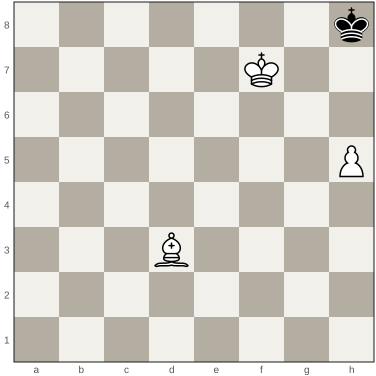
A bishop and a rook pawn (an a or h pawn) against a lone king usually win, but the bishop must be the right colour: the colour of the queening square. Here the pawn on h5 will queen on h8, which is a dark square, and White’s bishop is light-squared. It can never attack h8, so Black’s king shelters in the corner and cannot be driven out.
Careless play even gives stalemate: the natural Bd3 takes h7 away and leaves the king no move.

- 1. Bd3 Black has no move and is not in check: stalemate.
A question
Now the same position, but White’s bishop is on c1. That is a dark square, like h8. It is White’s move. Does White win?

Show the answer
Yes. The bishop is the same colour as the queening square.
Right. A dark-squared bishop can attack h8, so the king cannot shelter in the corner for ever. With the white king’s help it is driven out and the pawn goes through. White wins.
In numbers
Positions to practise
16 positions in the study, every result proved by the tablebase: 5 are wins, 9 draws and 2 losses for the side to move, with best play on both sides.