Chess lessons › Famous chess games
The Romantic era
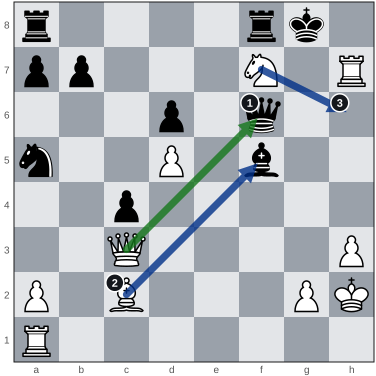
Gambits, open lines and sacrifices: La Bourdonnais against McDonnell, London 1834.
The idea
Gambits and sacrifices: La Bourdonnais mates McDonnell in 1834.
- The queen takes the queen on f6 and gives up the rook on h7.
- The bishop on c2 is ready to take on f5 with check.
- After Qxf6 Kxh7 Bxf5+ Kg8, Nh6 is mate.
In a game: When the enemy queen is the king’s last guard, see if taking it opens a mate.
How the lesson begins
For much of the nineteenth century, the best players played to attack. They opened with gambits, brought their pieces out fast and gave up material to reach the enemy king. Writers later called this the Romantic era of chess. The Immortal Game of 1851 is its most famous example.
In 1834 the best French player, Louis-Charles Mahé de La Bourdonnais, played a long series of matches in London against the best player in Britain and Ireland, the Irishman Alexander McDonnell. Here is one of their games. La Bourdonnais has White.

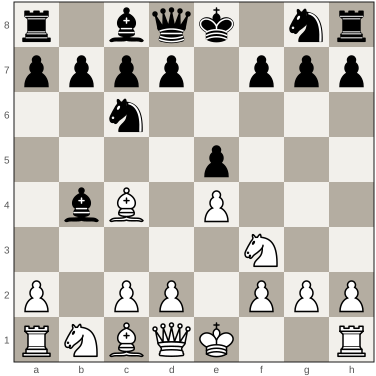
White starts with the Italian Game, and on move four offers a pawn.
- 1. e4 e5 2. Nf3 Nc6 3. Bc4 Bc5 4. b4 White offers the b-pawn. This is the Evans Gambit, named after Captain William Evans, who brought it into play a few years before this match.
- 4... Bxb4 Black takes it.
A question
Why does White give up the pawn?
Show the answer
To gain time: c3 will attack the bishop, and d4 will build a big centre while White’s pieces come out quickly..
Right. That is the Romantic way: a pawn for time, open lines and an attack.