Chess lessons › Famous chess games
Steinitz and the classical school
Small advantages add up: Steinitz beats Zukertort in their 1886 world championship match.
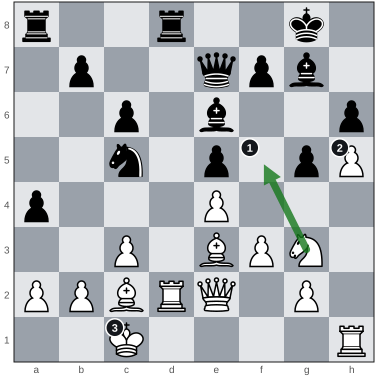
The idea
Steinitz builds up small advantages and beats Zukertort in 1886.
- No black pawn can attack f5, so the knight can settle there.
- The pawn on h5 takes space in front of Black’s king.
- White’s king is safe on c1, away from the kingside pawns.
In a game: Before you attack, collect small advantages: space, strong squares and a safe king.
How the lesson begins
Wilhelm Steinitz became the first official world champion in 1886, when he beat Johannes Zukertort in a match. In the Romantic era many masters went straight for the enemy king. Steinitz taught that an attack only works when you already have an advantage, and that small advantages add up: a weak square, a better pawn structure, more space. Steinitz called this the modern school; it is also known as the classical school.
Siegbert Tarrasch, a German doctor and a leading player of the 1890s, made the ideas into rules in his books: take the centre, develop quickly, put your rooks on open files. Here is Steinitz, with White, against Zukertort in their 1886 match.

Steinitz plays slowly. He prepares d4 with c3, and after the trades on e5 the pawns on e4 and e5 block each other.
- 1. e4 e5 2. Nf3 Nc6 3. Bb5 Nf6 4. d3 A quiet move. The centre can wait.
- 4... d6 5. c3 g6 6. d4 Now d4, with the pawn on c3 behind it.
- 6... Bd7 7. Nbd2 Bg7 8. dxe5 White takes on e5.
- 8... Nxe5 9. Nxe5 dxe5 10. Qe2 O-O
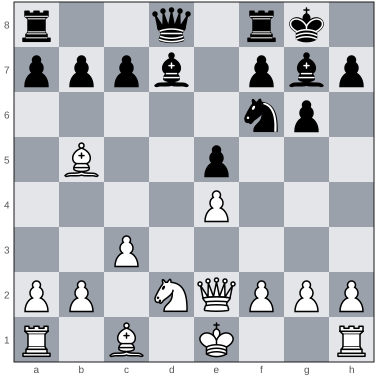
White keeps the king in the centre and gains space on the kingside with h4 and h5. The knight goes round to g3, and then Steinitz castles queenside, away from his own pawns.
- 11. Bd3 Qe7 12. f3 Bc6 13. Nb3 a5 14. Be3 Nd7 15. h4 The h-pawn goes forward.
- 15... a4 16. Nd2 h6 17. h5 And on to h5.
- 17... g5 18. Nf1 Nc5 19. Bc2 Rfd8 20. Ng3 Bd7 21. O-O-O White castles queenside.
- 21... c6 22. Rd2 Be6
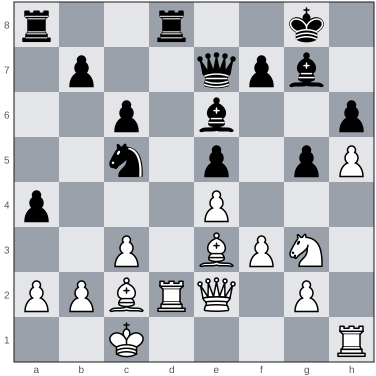
Find the move
White to move. Put the knight on a square that no black pawn can attack.
A hint
The knight on g3 can reach a square near Black’s king.
Show the answer
23. Nf5
Nf5. No black pawn attacks f5, so only a piece can challenge the knight. Zukertort gave his bishop for it, and after exf5 White’s pawns on f5 and h5 cramp Black’s kingside.