Attacking the king
Sacrifices that open up a king, and how to tell when an attack is sound.
The idea
Give up a piece to open the enemy king, when the attack is sound.
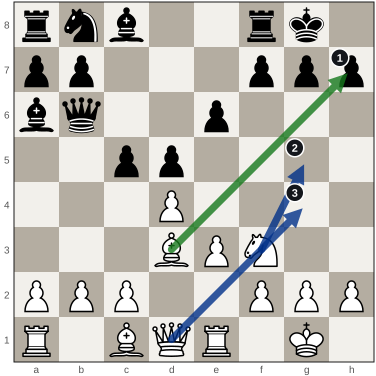
- The bishop gives itself up here, with check.
- If the king takes it, the knight jumps in with check.
- The queen joins the attack, and the king stands in the open.
In a game: Before you give up a piece near the king, count your attackers against its defenders.
How the lesson begins
The Greek gift is the most famous attack on a castled king. White gives up the bishop on h7 with Bxh7+. If the king takes it, the knight comes in with check, Ng5+, and the queen follows to g4. The king is dragged out into the open, and White has a strong attack for the piece.
It only works when Black has nothing to defend h7 and g5. Here Black has no knight on f6, and the queen and bishops are far away on the other wing. Press Next move.
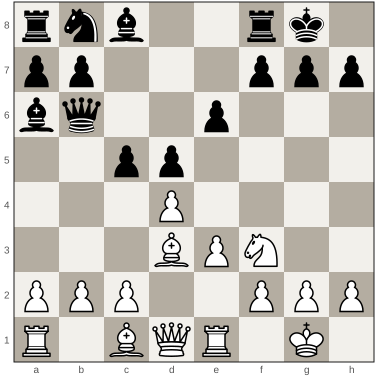
- 1. Bxh7+ The bishop gives itself up for a pawn. If the king does not take it, White simply keeps the pawn with check.
- 1... Kxh7 The king takes the gift.
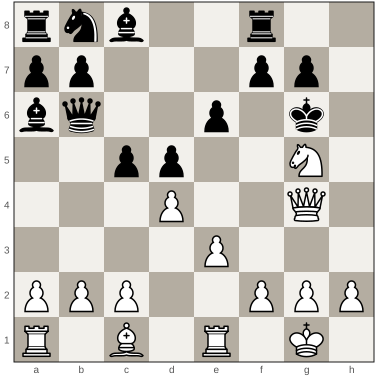
- 2. Ng5+ Check again. If the king goes back to g8 or h8, Qh5 wins quickly, so it runs out to g6.
- 2... Kg6 The king runs to g6.
- 3. Qg4 The queen joins the attack. The black king is exposed, and its pieces are far away.
A question
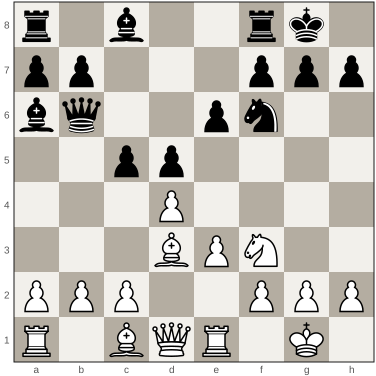
Now Black has a knight on f6, and everything else is the same. Is Bxh7+ still a good idea?
Show the answer
No, the knight on f6 takes the bishop, and White loses a piece.
Right. A Greek gift usually needs h7 to be guarded by the king alone. A knight on f6 guards it too, so here the bishop is simply taken and White is a piece down for a pawn.
In numbers
In the puzzle bank
3,262 puzzles in GreyChess’s bank practise it. Half of them are rated between 947 and 2,030.
The piece that makes the first move of the answer: queen 41%, rook 24%, knight 20%, bishop 12%, pawn 3%, in puzzles from the Lichess puzzle database.