Pins
A piece that cannot move without exposing something worth more behind it.

The idea
A piece that cannot move without exposing a bigger one behind it.
- The bishop attacks the knight.
- The king stands behind it on the same line.
- So the knight cannot move: it is pinned.
In a game: Look for two enemy pieces on one line, the more valuable one behind.
The lesson
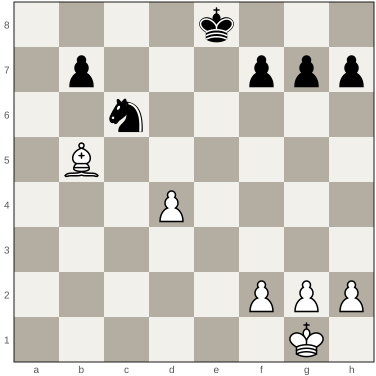
A pin is an attack on a piece that cannot move without exposing something more valuable behind it. Here the bishop on b5 attacks the knight on c6. Behind the knight, on the same diagonal, stands the black king.
The knight is pinned to the king. If it moved, the king would be in check, and that is against the rules, so this knight has no legal move at all. A pin to the king is called an absolute pin.

Find the move
Now you make the pin. White to move: pin the black knight to its king.

A hint
Put the bishop on the diagonal that runs through the knight to the king.
Show the answer
1. Bb5
Bb5 attacks the knight, and the king stands behind it on the same diagonal. The knight is pinned, and nothing defends it yet, so White threatens to take it with Bxc6+.
A pin does not always involve the king. Here the bishop on g5 attacks the knight on f6, and behind the knight stands the black queen. This is a relative pin: the knight is allowed to move, but if it does, the bishop takes the queen.
Suppose Black ignores the pin. Press Next move.
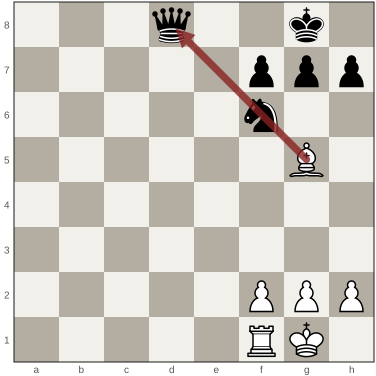
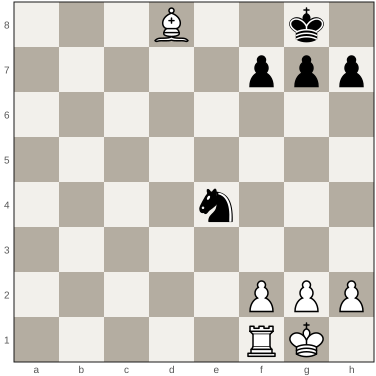
- 1... Ne4 The knight jumps away and attacks the bishop, but it has opened the diagonal to the queen.
- 2. Bxd8 The bishop takes the queen. Nothing can take it back.
A question
Black to move. Both knights are pinned by a bishop. What is the difference between the two pins?

Show the answer
The knight on c6 cannot move at all. The knight on f6 can move, but then the bishop takes the queen.
Right. The pin to the king is absolute, so the knight has no legal move. The pin to the queen is relative: the knight may move, but the bishop on g5 then attacks the queen.
Find the move
White to move. Black’s knight on c6 is pinned to its king, so it cannot run away. Attack it again: find the pawn move that wins it.
A hint
A pawn can attack the knight too. Which pawn can move forward to do it?
Show the answer
1. d5
d5 attacks the pinned knight with a pawn. The knight cannot move, and a pawn is worth less than a knight, so Black loses a piece. Moving the king does not help: White just takes the knight.
Find the move
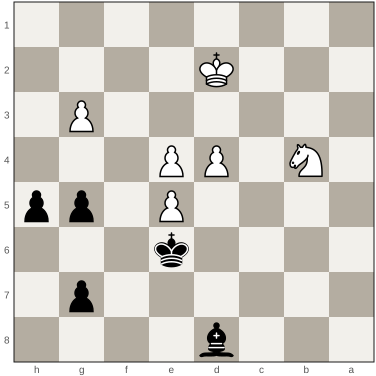
Black to move. Find the move that pins a piece and wins it.
A hint
Look for a bishop move that attacks a piece with the white king behind it.
Show the answer
45... Ba5 46. Kd3 Bxb4
Ba5 attacks the knight on b4, and the white king stands behind it on the same diagonal. The knight is pinned, so it cannot run away, and Black wins it.
Find the move
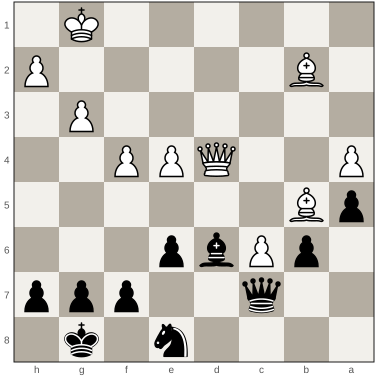
Black to move. A pinned queen is a big prize. Find the move.
A hint
The white king stands on g1, on the same diagonal as the queen.
Show the answer
27... Bc5 28. Kg2 Bxd4
Bc5 attacks the queen on d4 and pins it to the king on g1. The queen can only move along the diagonal: to e3 or f2, where the bishop still attacks her, or to c5, where the pawn on b6 takes her. So Black wins the queen for a bishop.
Practise
Now some on your own. They get a little harder as you do well.
In the lesson, 5 rated puzzles on this theme come from the puzzle bank, chosen near your rating.
In numbers
In the puzzle bank
1,980 puzzles in GreyChess’s bank practise it. Half of them are rated between 1,398 and 2,422.
The piece that makes the first move of the answer: rook 33%, queen 27%, knight 19%, bishop 13%, pawn 7%, king 2%, in puzzles from the Lichess puzzle database.