Keeping score
In a slow game, each player writes down every move on a scoresheet, after making it.

The idea
In slow games, write down every move after you make it.
- White plays a move on the board first.
- Then White writes it down: “1. e4”.
- Black’s reply goes beside it, and so on through the game.
In a game: Write each move after you play it, never before.
How the lesson begins
In a slow over-the-board game, each player writes down every move of the game, theirs and their opponent’s, on a scoresheet. The moves are written in algebraic notation, one by one, as clearly as you can.
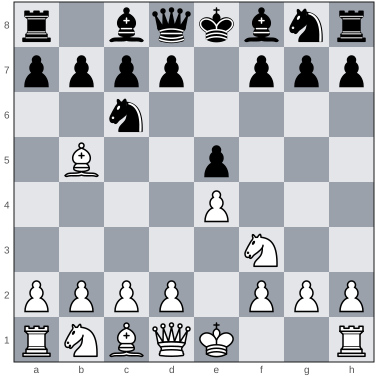
Step through the moves. A scoresheet would read 1. e4 e5 2. Nf3 Nc6 3. Bb5: White’s move and Black’s reply side by side, with the move number in front.

- 1. e4 e5 2. Nf3 Nc6 3. Bb5 White’s third move, written “3. Bb5”.
A question
When do you write your move down?
Show the answer
After you have made it on the board.
Right. Writing a move before you play it is not allowed, except in a few rare cases, such as claiming a draw by repetition or the fifty-move rule.