Protecting your pieces
When a piece is attacked, move it, defend it, or take the piece that attacks it.
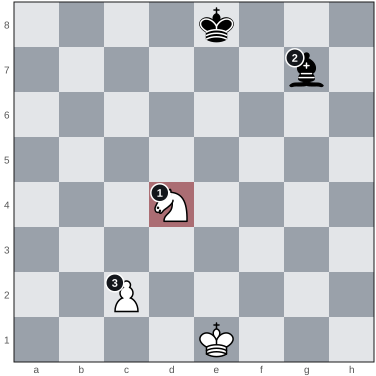
The idea
Move it, defend it, or capture the piece attacking it.
- The bishop attacks the knight, and nothing defends it.
- The bishop attacks along this diagonal.
- This pawn can step to c3 to defend the knight.
In a game: When a piece is attacked, ask: can it move, can I defend it, or can I take the attacker?
The lesson
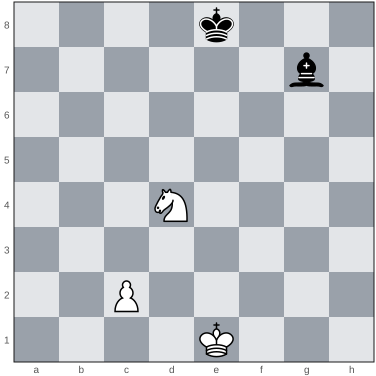
The black bishop attacks the white knight. If White does nothing, Black can take the knight next move and get nothing back for it.
A piece is hanging when it is attacked and nothing defends it. When one of your pieces is attacked, there are three simple ways to save it. Move it to a safe square. Defend it. Or take the piece that attacks it.
A question
If White does nothing about the attacked knight, what happens?
Show the answer
Black can take it, and White gets nothing back.
Right. A hanging piece can simply be taken. White just loses it.
Find the move
The first way: move the knight to a square the bishop does not attack.
A hint
A bishop moves along diagonals. Jump the knight off the bishop’s diagonal.
Show the answer
1. Nb5
Each of these squares is off the bishop’s diagonal, so the bishop cannot take the knight there. Moving the piece away is often the easiest way to save it.
Find the move
The second way: defend the knight. Find the pawn move that guards it.
A hint
A pawn guards the two squares just in front of it, one step to each side.
Show the answer
1. c3
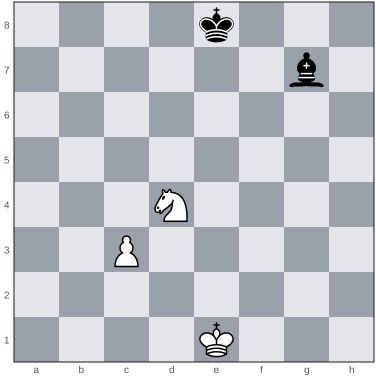
c3 puts the pawn one square diagonally behind the knight, where it guards d4. If the bishop takes the knight, the pawn takes the bishop back. White gives a knight and gets a bishop: a fair swap.
A question
After c3, the knight on d4 is defended. What does “defended” mean?
Show the answer
If Black takes the knight, White can take back.
Right. Being defended does not stop the capture. It means you get something back for your piece.
Find the move
The third way: take the attacker. Black to move. The white bishop attacks Black’s knight on e5. Find the move that takes the bishop.

A hint
Look along the b-file. A piece that has been taken cannot attack anything.
Show the answer
1... Rxb2
Rxb2 takes the bishop that was attacking the knight. Now nothing attacks the knight, and Black has won a bishop.
A question
You want to defend a piece, and a pawn can do it. Is a pawn a good defender?
Show the answer
Yes: a pawn is worth the least, so it is the cheapest guard.
Right. Your bigger pieces stay free for other jobs.
A question
Which of these is NOT a good way to deal with an attacked piece?
Show the answer
Leave it and hope the other side does not see it.
Right, this is not a good plan. Hoping is not a move. A careful player will simply take the piece.