Chess lessons › Checkmate patterns
Mate in four and more
Long mates come from checks first, then captures, then quiet moves.
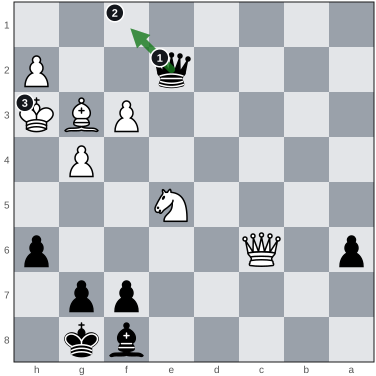
The idea
Long mates come from forcing moves that leave few replies.
- Start with the checks: Black’s queen has three to choose from.
- Pick the check that cannot be taken, so the king has one move.
- Each later check leaves one reply too, so you can see the whole line.
In a game: List your checks and captures, count the replies to each, and follow the one with fewest.
How the lesson begins
A mate in four is a forced mate on your fourth move, whatever the other side replies. You cannot look at every move, so you look at forcing moves, in this order. First the checks, because the other side must answer them. Then the captures, which also leave few replies. Last the quiet moves that take squares away from the king.
Here Black’s queen is on e2 and White’s king is on h3, boxed in by its own bishop on g3, pawn on g4 and pawn on h2. Black has three checks: Qg2+, Qxh2+ and Qf1+. Count the replies to each.
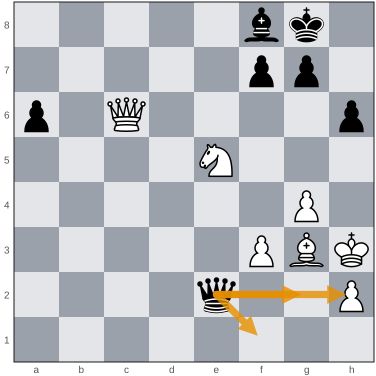
Find the move
Mate in four. Which of the three checks leaves White the fewest replies?
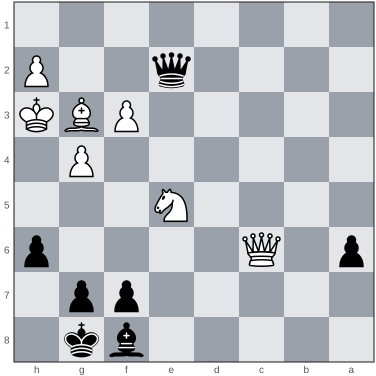
A hint
Two of the checks can be taken at once. One cannot.
Show the answer
44... Qf1+ 45. Kh4 g5+ 46. Kh5 Qh3+ 47. Bh4 Qxh4#
Qf1+. The king cannot take the queen and nothing can block on g2, so White’s only move is Kh4. Then g5+ forces Kh5, Qh3+ forces Bh4, and Qxh4 is mate. Every reply was the only legal move.
In numbers
In the puzzle bank
1,730 puzzles in GreyChess’s bank practise it. Half of them are rated between 1,671 and 2,352.
The piece that makes the first move of the answer: queen 37%, rook 34%, knight 13%, bishop 10%, pawn 6%, in puzzles from the Lichess puzzle database.