Chess lessons › Chess endgames
Active defence in rook endings
A rook that only guards usually loses; checks, attacks and your own passed pawn save half points.

The idea
A rook that only guards often loses: check, attack, push your pawn.
- White’s a-pawn on a6 is close to queening.
- Black’s own passed pawn on g4 is the defence.
- g3 pushes it at once; a quiet rook move such as Rc7 loses.
In a game: Defending a rook ending, ask first: can my rook check, attack a pawn, or back my own pawn?
How the lesson begins
When you defend a rook ending, keep your rook active: checking the enemy king, attacking pawns, or supporting a passed pawn of your own. A rook that only stands guard is usually lost. You have seen this in the Philidor position, where the rook waits on its third rank and then goes to the far side to check from behind.
This is Max Judd against Jackson Showalter, St Louis 1890. White is two pawns up, but the tablebase says it is a draw. Black’s rook on a7 is only guarding the seventh rank.
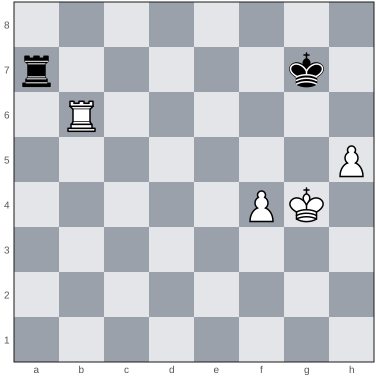
Find the move
Black to move. Only four moves keep the draw, and all of them are rook moves. Find one.
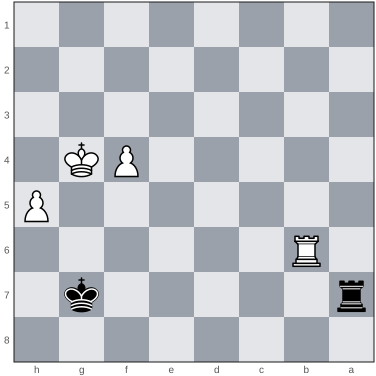
A hint
Your rook does nothing on a7. Put it where it can check or attack.
Show the answer
54... Ra1
The rook must come off the seventh rank. Ra5 attacks the pawn on h5 along the fifth rank; Ra1, Ra2 and Ra3 get ready to check White’s king from below. Each keeps the draw. Showalter played Kh7, a quiet king move; 55.Kg5 followed, and White won.
In numbers
Positions to practise
64 positions in the study, every result proved by the tablebase: 30 are wins, 29 draws and 5 losses for the side to move, with best play on both sides.