Chess lessons › Chess endgames
Knight endings
A passed pawn ties the enemy knight down, and then the king does the work, as in a pawn ending.

The idea
A passed pawn ties the knight down, and the king does the work.
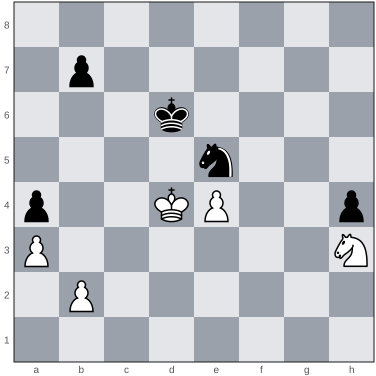
- Black’s pawn on h4 is passed.
- White’s knight must stay near h3 to stop it.
- So Black’s king is free, and Kf3 goes after the knight.
In a game: In a knight ending, look for a passed pawn that ties the enemy knight, then use your king.
How the lesson begins
Knight endings play much like king and pawn endings. The same things count: an active king, and a passed pawn far from the enemy king. A knight is a short-range piece, so it struggles to stop a pawn on one wing and help on the other.
This is Emanuel Lasker against Aaron Nimzovich, Zürich 1934. Material is level. Black has a passed pawn on h7, far from the centre; White’s passed pawn on e4 is in the middle of the board. Black’s knight stands in the centre on d4; White’s is back on g1. The engine gives Black a small edge.
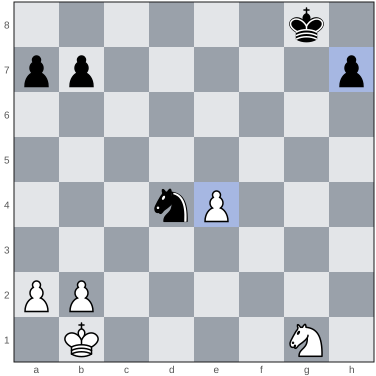
Many moves later both kings are in the centre. Watch Black’s h-pawn go forward, and where White’s knight has to go.
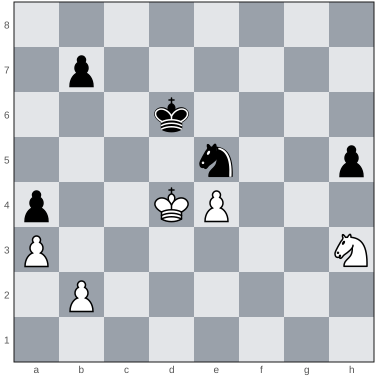
- 52. Nf4 h4 The h-pawn moves on, and the knight must stop it.
- 53. Nh3 The knight now stands on h3, right in front of the pawn. It is safe there, but from now on it can only step to squares where it still watches h3.
A question
White’s knight now sits on h3, in front of the pawn. What does that mean for the rest of the game?
Show the answer
The knight is tied to the h-pawn, so Black’s king is free to go wherever it likes.
Right. White’s knight cannot help against Black’s king anywhere else. Nimzovich’s king went to the queenside next.