Chess lessons › Chess endgames
Endgame principles: do not hurry
In a won ending, improve every piece first, take no risks, and push your pawns only when they are ready.
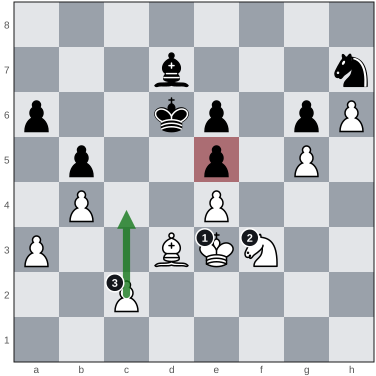
The idea
In a won ending, improve every piece before you push a pawn.
- For thirteen moves only White’s king, knight and bishop moved.
- Nxe5 would lose the knight: the king on d6 defends the pawn.
- Only then c4, the pawn break that opens the queenside.
In a game: Winning an ending, ask which piece can still improve before you push a pawn or grab one.
How the lesson begins
Endgame books give a simple rule: do not hurry. When you are winning an ending, improve every piece first, take no needless risks, and push your pawns only when everything is ready.
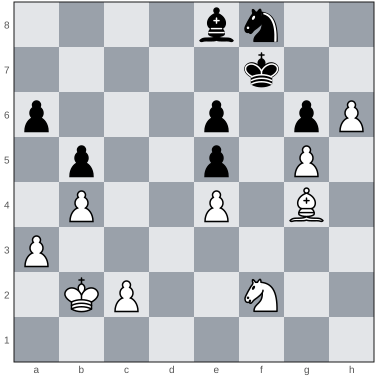
This is Viswanathan Anand against Ruslan Ponomariov, Corus 2005. White is a pawn up and has a passed pawn on h6. The engine rates White as winning. White to move.
Find the move
Start with the piece that does least: the king on b2. Find the king move that heads for the centre.
A hint
In the endgame the king belongs in the centre.
Show the answer
45. Kc3
Kc3, and Anand’s king went on to d3 and e3. The engine rates it among the best moves. From the centre the king can go to either side of the board when it is needed.