Chess lessons › Chess endgames
Four pawns against three on one side
Usually a draw: the stronger side pushes for a passed e- or f-pawn, the defender keeps the rook active.

The idea
Usually a draw: the defender keeps the rook far away and active.
- White wants e5, which takes d6 and f6 from Black’s rook.
- Rc1 keeps the rook far away, with the sixth rank in reach.
- Black’s king on g6 stands in front of White’s pawns.
In a game: Four pawns against three on one wing: defend with a far rook; attack with slow pawn moves.
How the lesson begins
Rook endings with four pawns against three on one side, and no other pawns, are usually drawn with good defence. The defending king stands in front of the pawns, and the stronger side has no passed pawn to push.
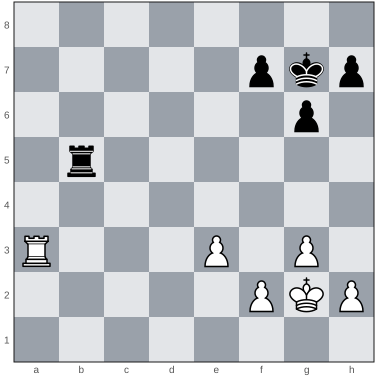
This is José Raúl Capablanca against Frederick Yates, Hastings 1930/31. White has pawns on e3, f2, g3 and h2 against f7, g6 and h7. White to move. The engine rates the position as level.
A question
How can White try to win a position like this?
Show the answer
Move the pawns up slowly to make a passed pawn, usually the e- or f-pawn, and bring the king up behind them.
Right. Black has no pawn on the d- or e-file, so the e-pawn is White’s spare pawn. Pushed with the f-pawn beside it, it can become a passed pawn: a pawn with no enemy pawn in front of it on its own file or a neighbouring file.