Chess lessons › Chess endgames
Queen against rook
Pass the move to reach the Philidor position, then fork king and rook; watch for the rook’s stalemate checks.

The idea
Make the rook leave its king, then fork king and rook.
- Black’s rook on b1 has left its king.
- Qh7+ checks along the seventh rank and attacks b1.
- Black must answer the check; then the queen takes the rook.
In a game: Against a lone rook, look for a check that also attacks the rook.
How the lesson begins
A queen against a rook usually wins, but the rook can resist for a long time. Its best defence is to stay right beside its own king, so that the queen cannot attack both at once.
This is the Philidor position, named after Philidor, who analysed it in 1777. (It is not the rook ending of the same name.) Black’s king is on the edge and the rook stands beside it on b7. With Black to move, the tablebase says Black is lost.
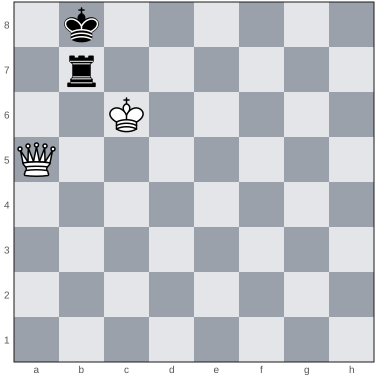
Black must move, and every move loosens the defence. Here the rook goes far away, to b1. Step through how the queen answers: each check pushes the king, until the queen can reach a square that attacks the king and the rook together.
- 1... Rb1 The rook leaves its king.
- 2. Qd8+ Ka7 3. Qd4+ A check along the diagonal to a7.
- 3... Ka8 4. Qh8+ Ka7

Find the move
White to move. Black’s rook is on b1, far from its king. Win the rook.
A hint
Find a check from a square that also looks at b1.
Show the answer
5. Qh7+
Qh7+ checks the king along the seventh rank and attacks the rook on b1 along the diagonal. This double attack is a fork. Black must answer the check, and the queen then takes the rook, on b1 or on b7 if it comes back to block.