Chess lessons › Chess endgames
Rook and two pawns against rook
Connected pawns walk through with their king; f- and h-pawns are the hard case, and one slip decides it.
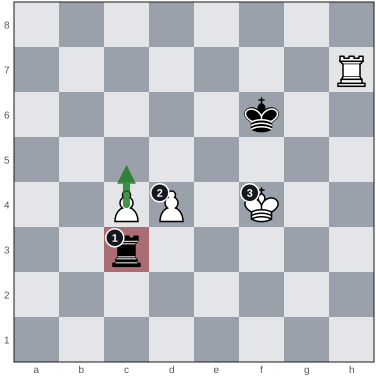
The idea
Connected pawns walk through; split f- and h-pawns can be a draw.
- Black’s rook on c3 attacks the pawn on c4.
- After c5 the pawn on d4 protects it, so the rook cannot take it.
- Then White’s king walks up beside its pawns.
In a game: With two extra pawns, keep them protecting each other and bring the king up beside them.
How the lesson begins
With a rook each and two extra pawns, the stronger side usually wins. Connected pawns, on neighbouring files, are the easiest: they can protect each other, and the king walks up beside them.
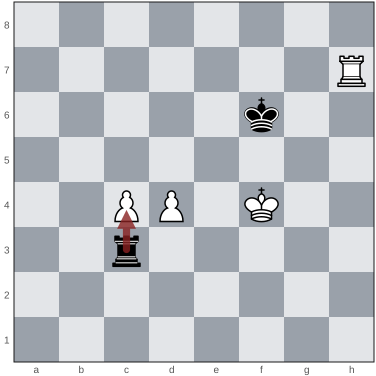
This is Hugh Alexander Kennedy against Marmaduke Wyvill, London 1851. White has pawns on c4 and d4. White to move. Look at the black rook on c3.
Find the move
White to move. The pawn on c4 is attacked and nothing protects it. Only three moves keep the win. Find one.
A hint
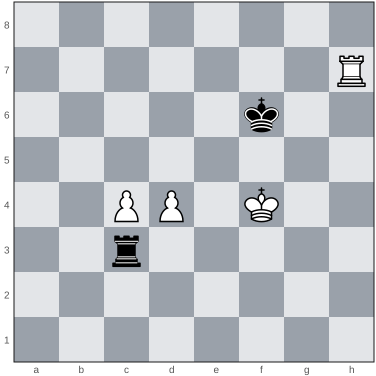
Move the pawn to a square where the other pawn protects it.
Show the answer
55. c5
c5 is the simplest: on c5 the pawn is protected by the pawn on d4, so the rook cannot take it. Kennedy played it. Rc7, guarding the pawn along the c-file, and Rh6+, a check first, also keep the win. Every other move lets the pawn go and throws the win away.
In numbers
Positions to practise
64 positions in the study, every result proved by the tablebase: 30 are wins, 29 draws and 5 losses for the side to move, with best play on both sides.