Chess lessons › Chess endgames
Triangulation
When you need the same position with the other side to move, walk your king round a triangle.

The idea
Walk your king round a triangle so the other side has to move.
- The kings face each other and it is White’s move, so White steps away.
- The king goes on to d4, the next corner of the triangle.
- Back on d5 after three moves, with Black to move this time.
In a game: If you need the same position with the other side to move, look for a triangle for your king.
How the lesson begins
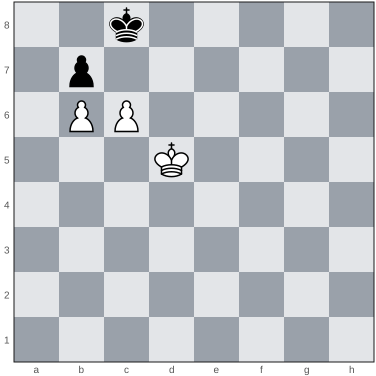
White has two pawns against one, and Black’s king blocks them. The kings face each other on the d-file with one square between, and it is White’s move. So Black has the opposition: White cannot step forward.
With Black to move, Black’s king would have to give way and White would win quickly. White wants this same position with Black to move. The way to get it is triangulation: the king walks round three squares that touch each other and comes back, so it spends three moves where Black can only spend two.

The pawn push c6+ looks natural, but it only draws. Black does not take: the king steps to c8, and White cannot get through.

- 1. c6+ Kc8
Find the move
Do not push the pawn. Start a triangle with your king.
A hint
Step to a square next to d5. You will come back to d5 later.
Show the answer
1. Ke5
Every king move wins here, and Ke5 is a good one: the king can come back by Kd4 and Kd5, three moves round the triangle d5, e5, d4. The only move that throws the win away is c6+.
In numbers
Positions to practise
120 positions in the study, every result proved by the tablebase: 41 are wins, 59 draws and 20 losses for the side to move, with best play on both sides.