Chess lessons › Famous chess games
Chess in the computer age
Kramnik’s Berlin endgame beats Anand in a rapid game at Mainz in 2001.
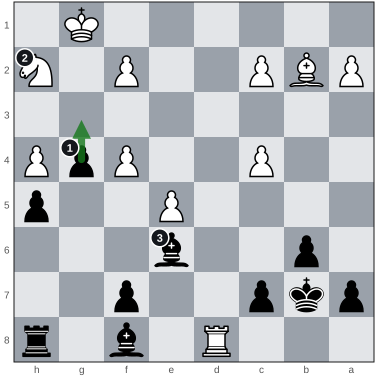
The idea
Kramnik’s Berlin endgame beats Anand in a rapid game at Mainz, 2001.
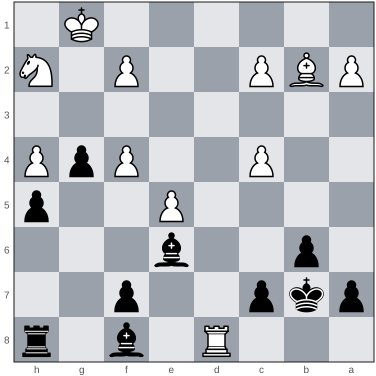
- The pawn on g4 goes to g3 and attacks f2 and h2.
- The pawn on g3 would attack the knight on h2.
- Later the bishop on e6 takes on c4 and joins the attack.
In a game: With the queens off, pawns can still break open the enemy king.
How the lesson begins
In 1997 the IBM computer Deep Blue beat the world champion Garry Kasparov in a six-game match. In 2006 the program Deep Fritz beat the world champion Vladimir Kramnik by four points to two. Today a free engine on a phone plays stronger than any human.
Top players now prepare at home with engines and with databases of millions of games. Openings are checked many moves deep, and old ideas come back when the engine shows they hold.

Kramnik chose the Berlin Defence for his world championship match against Kasparov in London in 2000. Kasparov could not break it, and he did not win a game in the match. Here is Viswanathan Anand, with White, against Kramnik in a rapid match at Mainz in 2001.
The queens are off at move eight, and Black’s king stands on d8. Black’s c-pawns are doubled, but Black has the two bishops.
- 1. e4 e5 2. Nf3 Nc6 3. Bb5 Nf6 The Berlin Defence.
- 4. O-O Nxe4 Black takes the pawn on e4 at once.
- 5. d4 Nd6 6. Bxc6 dxc6 7. dxe5 Nf5 8. Qxd8+ The queens are traded.
- 8... Kxd8
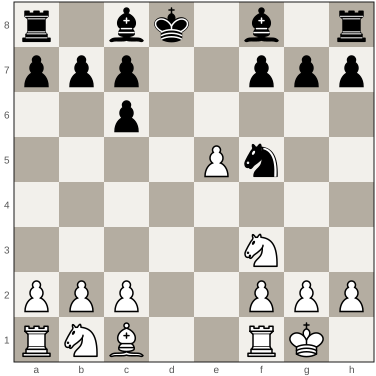
Kramnik walks his king to the queenside and pushes his kingside pawns. One pair of rooks is traded on a8.
- 9. Nc3 h6 10. h3 Bd7 11. b3 Kc8 12. Bb2 b6 13. Rad1 Ne7 14. Rd2 c5 15. Rfd1 Be6 16. Ne2 g5 17. h4 g4 18. Nh2 h5 19. Rd8+ Kb7 20. Rxa8 Kxa8 21. Rd8+ Kb7 22. Nf4 Ng6
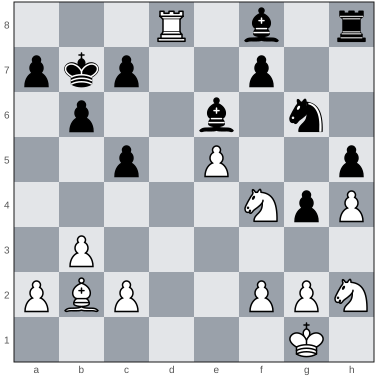
Kramnik gives a pawn with c4, then takes the knight on f4, and White takes back with the g-pawn.
- 23. g3 c4 24. bxc4 Nxf4 25. gxf4
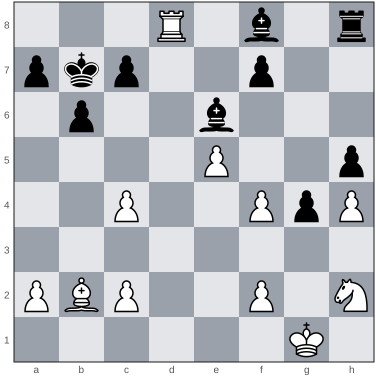
Find the move
Black to move. Use the g-pawn to break open White’s king.
A hint
The pawn on g4 can go forward.
Show the answer
25... g3
g3 attacks the pawn on f2 and the knight on h2.