Chess lessons › Famous chess games
Fischer against Spassky, 1972
The match in Reykjavik: Fischer’s first win, a trapped rook, and the last game.
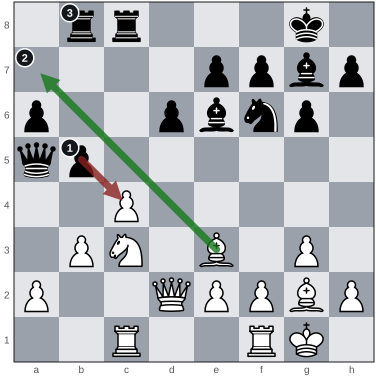
The idea
Fischer takes the world title from Spassky; Ba7 wins the exchange.
- Spassky’s pawn on b5 attacks the pawn on c4.
- The bishop goes from e3 to a7 and attacks the rook on b8.
- Spassky took on c4 and gave up the exchange, a rook for a bishop.
In a game: When a rook has few squares, look for a piece that can attack it.
How the lesson begins
In 1972 Bobby Fischer of the United States played Boris Spassky of the Soviet Union for the world title in Reykjavik, Iceland. Spassky had been champion since 1969.
The match nearly did not happen. Fischer lost the first game, did not turn up for the second and lost it by default. Here is the third game, the first one he won. Spassky has White.

Fischer answers 1.d4 with a Benoni. On move 11 he puts his knight on h5, where White can take it and break up the pawns in front of his king. Spassky takes.
- 1. d4 Nf6 2. c4 e6 3. Nf3 c5 4. d5 exd5 5. cxd5 d6 6. Nc3 g6 7. Nd2 Nbd7 8. e4 Bg7 9. Be2 O-O 10. O-O Re8 11. Qc2 Nh5 The knight goes to the edge, on h5.
- 12. Bxh5 gxh5 Black takes back with the g-pawn: the kingside pawns are doubled.
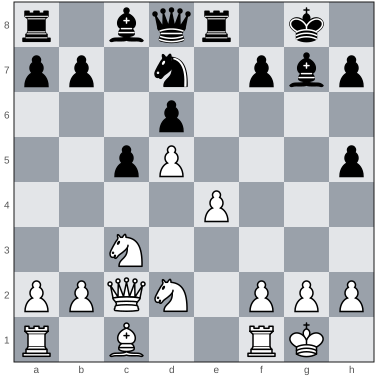
Both sides swap a pair of knights and line up their rooks on the e-file. Then Fischer gives his bishop for the knight on c3 and wins the pawn on e4, all four rooks come off, and his queen and bishop go after White’s king.
- 13. Nc4 Ne5 14. Ne3 Qh4 15. Bd2 Ng4 16. Nxg4 hxg4 17. Bf4 Qf6 18. g3 Bd7 19. a4 b6 20. Rfe1 a6 21. Re2 b5 22. Rae1 Qg6 23. b3 Re7 24. Qd3 Rb8 25. axb5 axb5 26. b4 c4 27. Qd2 Rbe8 28. Re3 h5 29. R3e2 Kh7 30. Re3 Kg8 31. R3e2 Bxc3 The bishop takes the knight on c3.
- 32. Qxc3 Rxe4 The rook takes the pawn on e4.
- 33. Rxe4 Rxe4 34. Rxe4 Qxe4 All four rooks are gone.
- 35. Bh6 Qg6 36. Bc1 Qb1 37. Kf1 Bf5 38. Ke2 Qe4+ 39. Qe3 Qc2+ 40. Qd2 Qb3 41. Qd4
Find the move
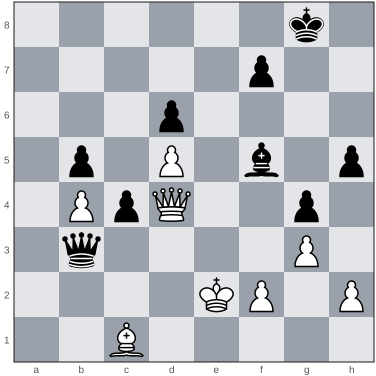
Black to move. Your queen and bishop are aimed at White’s king on e2. Find the check.
A hint
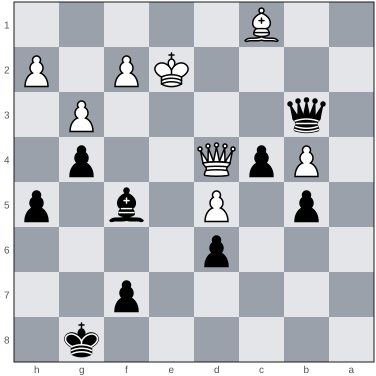
The bishop on f5 can check along a diagonal.
Show the answer
41... Bd3+
41...Bd3+ The bishop checks from d3, where the pawn on c4 guards it. The engine rates Black clearly winning, and Spassky resigned.