Chess lessons › Famous chess games
Where chess came from
From chaturanga in India to shatranj and to Europe, where the queen and bishop got their long moves.

The idea
Chess began in India, passed through Persia, and changed in Europe.
- In shatranj the ferz, the queen’s ancestor, moved one square diagonally.
- In Europe the queen got her long move, along any line.
- Now she crosses the board in one move, where the ferz took many.
In a game: When your queen crosses the board in one move, you use the rule that made modern chess.
The lesson
Chess is very old. Its earliest clear ancestor is chaturanga, played in India by the 6th century, about 1,500 years ago. It was a game of war on a board of 64 squares. Its pieces stood for the four parts of an army of that time: foot soldiers, horsemen, elephants and chariots, led by a king.
The pieces have changed since, but you would know the game. The king, the knight and the rook still move much as they did then.

From India the game travelled to Persia. After the Arabs conquered Persia in the 7th century, it spread across the Arab world as shatranj. Strong players there wrote down problems and studied the game closely.
Two of its pieces were much weaker than their modern versions. The next two questions show them.
A question
In shatranj the piece beside the king was the ferz, the ancestor of the queen. It moved just one square diagonally. Imagine the queen on d5 is a ferz. Where could it go?

Show the answer
Only to the four marked squares.
Right. One square diagonally: c4, c6, e4 or e6. The ferz was slow, and it took many moves to cross the board.
A question
The alfil, the ancestor of the bishop, jumped exactly two squares diagonally, over any piece in between. From c1 it could go only to a3 or e3, even with the pawn on d2 in the way. Because it always jumped two squares, how many squares of the board could one alfil ever reach?

Show the answer
8.
Right. An alfil was tied to just 8 squares of the board, and the two alfils of one side could never reach the same square.
Pawns in shatranj moved one square forward and captured one square diagonally, as they do now, but they never moved two squares on their first move. A pawn that reached the last rank became a ferz.
Chess reached Europe by about the year 1000, mainly through Spain and Italy. The ferz became the queen and the alfil became the bishop, but for centuries they kept their old, short moves.
Near the end of the 15th century, in southern Europe, the rules changed. The queen could now move any number of squares along a line, and the bishop any number of squares along a diagonal. The game became much faster.
From d5 the ferz reached 4 squares. The queen on d5 reaches the 27 marked squares.

Find the move
A ferz could never do this. White to move. Use the queen’s long move to give checkmate.

A hint
The b-file is open all the way to Black’s back rank.
Show the answer
1. Qb8#
Qb8# The queen crosses the board in one move. The king cannot go to g8, because the queen covers the whole back rank, and its own pawns block g7 and h7.
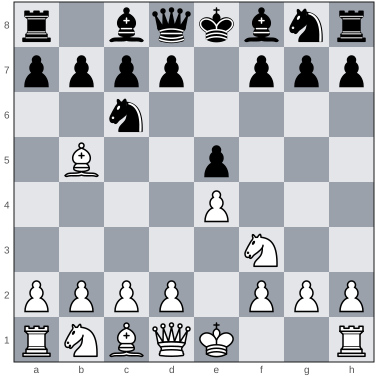
Books about the new chess followed. In 1561 Ruy López de Segura, a Spanish priest, published one, and the opening 1.e4 e5 2.Nf3 Nc6 3.Bb5 is named after him: the Ruy Lopez. It is still one of the most played openings. Step through it.
- 1. e4 e5 2. Nf3 Nc6 3. Bb5 An alfil on f1 could never reach b5 in one move.
A question
In which order did the game travel?
Show the answer
India, then Persia and the Arab world, then Europe.
Right. Chaturanga in India, shatranj in Persia and the Arab world, and then Europe, mainly through Spain and Italy.
A question
When did the queen get the long move she has today?
Show the answer
Near the end of the 15th century, in southern Europe.
Right. The queen and the bishop got their long moves then, and the game became much like the chess we play today.