Chess lessons › Good chess habits
Positions in the middle of a line
Stop at every position inside a line and ask what the side to move has, not only what you expect.
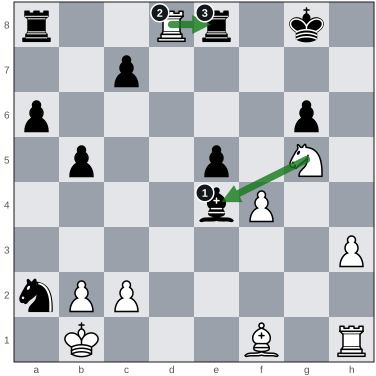
The idea
At each position in a line, look for a check or a capture first.
- Everyone expects Nxe4, taking the bishop on e4 back.
- But the rook on d8 is attacked twice and would be lost.
- First Rxe8+ takes a rook with check, and only then Nxe4.
In a game: Before you take back, ask whether either side has a check or a capture first.
How the lesson begins
A line you calculate is a chain of positions. The end matters most, but each position in the middle is a real position too: at each one the side to move may have something better than the move you expect.
This is Isidor Gunsberg against James Mortimer, London 1887. White’s rook has just taken the queen on d8, and Black’s bishop has taken White’s queen on e4. White to move. The move everyone expects is Nxe4, taking the bishop back.
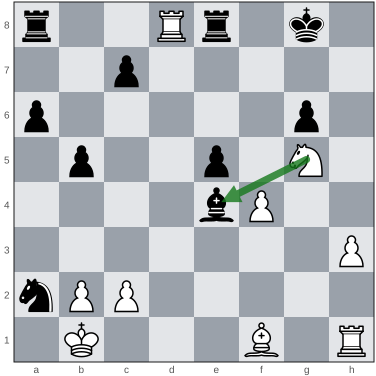
Play the expected move and look at the position after it. After Nxe4, Black takes the rook on d8, which nothing protects. White has taken a queen and a bishop, Black a queen and a rook, and the engine rates the position as about level.
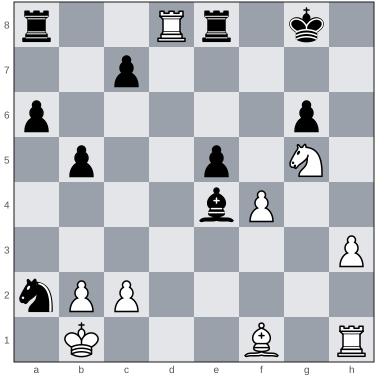
- 22. Nxe4 The bishop is taken back.
- 22... Raxd8 And the rook on d8 goes.
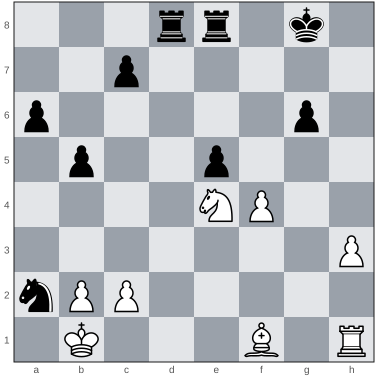
Find the move
Now stop before the recapture. Your rook on d8 is attacked twice. White to move: find the stronger move.
A hint
Your rook is lost anyway if you recapture first. Can it take something on its way out, with check?
Show the answer
22. Rxe8+
Rxe8+ takes a rook with check before taking the bishop back. Gunsberg played it: Black took back, Rxe8, and only then came Nxe4. White has won a whole rook more than in the plain line. Black’s only other answer was Kg7, and that loses too.
In numbers
In the puzzle bank
759 puzzles in GreyChess’s bank practise it. Half of them are rated between 1,348 and 2,364.
The piece that makes the first move of the answer: queen 25%, rook 24%, bishop 22%, knight 18%, pawn 10%, king 1%, in puzzles from the Lichess puzzle database.