Chess lessons › Chess openings
The Classical Caro-Kann
Why White chases the bishop with Ng3 and h4, why Black answers ...h6, and the plans that follow.

The idea
Black develops the bishop to f5 early and keeps it out of trouble.
- Ng3 chased the bishop, and it kept its diagonal on g6.
- Now h4 threatens h5, attacking the bishop again.
- ...h6 makes room, so after h5 the bishop drops back to h7.
In a game: When a pawn on h4 threatens to chase your bishop on g6, make room with ...h6.
How the lesson begins
Find the move
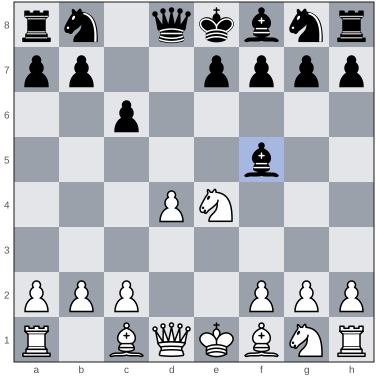
White to move. In the Classical Variation, 1.e4 c6 2.d4 d5 3.Nc3 dxe4 4.Nxe4 Bf5, the bishop attacks your knight on e4. Move the knight and hit the bishop in return.
A hint
Which knight square attacks f5?
Show the answer
5. Ng3
5.Ng3 is the engine’s top choice. The knight on g3 attacks the bishop, and after 5...Bg6 the bishop stays on its diagonal.
Find the move
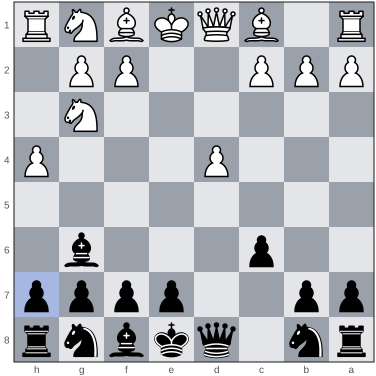
Black to move. White threatens h5, attacking the bishop. Make a retreat square for it first.
A hint
The bishop wants h7, but a pawn is there.
Show the answer
6... h6
6...h6 is the engine’s top choice. Now after h5 the bishop can drop back to h7. Lichess calls 6.h4 the Main Line of the Classical Variation.
In numbers
How often it is played
| Rating | Value |
|---|---|
| Under 800 | Too few games |
| 800 to 1199 | 0.8 |
| 1200 to 1599 | 1.2 |
| 1600 to 1999 | 1.8 |
| 2000 and up | 2.4 |
How the games ended
White won 50%, 5% were drawn and Black won 45%, over 2,812 games that start this way, in a sample of rated Lichess games from 2026.