Chess lessons › Chess openings
The English: its main systems
The Reversed Sicilian, the Symmetrical English, the Botvinnik System and the answer 1...Nf6.
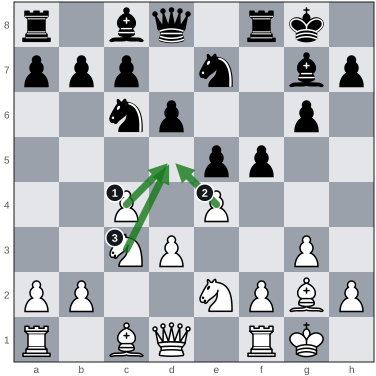
The idea
White’s pawns on c4 and e4, with a knight on c3, hold d5.
- The pawn on c4 attacks the square d5.
- A second pawn on e4 attacks d5 as well.
- The knight can then land on d5, where both pawns guard it.
In a game: Pawns on c4 and e4 and a knight on c3 together hold d5: the Botvinnik idea.
How the lesson begins
After 1.c4 Black has many answers. In Lichess games where the two players’ average rating is 1200 to 1599, which is club level rather than master level, the four most played are 1...e5 (41% of those games), 1...Nf6, 1...d5 and 1...c5.
This lesson follows White’s plan against three of them: the Reversed Sicilian after 1...e5, the Symmetrical English after 1...c5, and the King’s Indian and Queen’s Gambit set-ups after 1...Nf6. One idea runs through the first two, the Botvinnik System: a c-pawn and an e-pawn, both on the fourth rank, that keep d5 under White’s control.
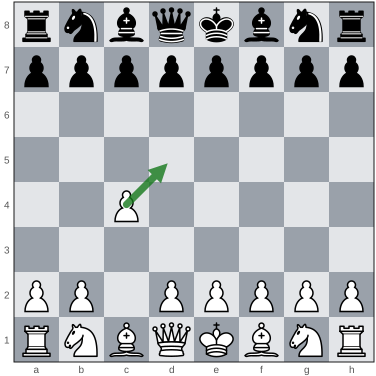
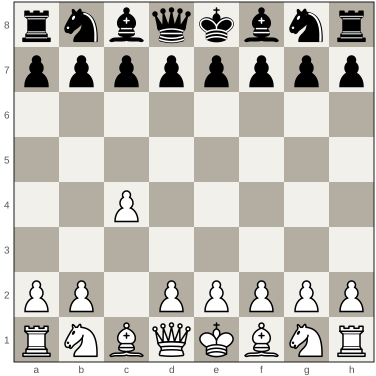
1...e5 takes the centre. White’s c-pawn faces Black’s e-pawn, which is the pattern of the Sicilian with the colours reversed, so this is the Reversed Sicilian. Step through a common set-up. After the first move Black’s moves copy White’s, and Lichess calls the final position the Closed System, Full Symmetry.
Swap the colours and mirror the board from top to bottom, and the position is the Closed Sicilian, with one difference. In the Closed Sicilian the side with the c-pawn is waiting for the other side’s move; here the side with the c-pawn is the one to move. White is playing Black’s side of that Sicilian with an extra move.
- 1... e5 Black takes the centre with the e-pawn.
- 2. Nc3 The knight watches d5, the square White’s c-pawn attacks.
- 2... Nc6 Black develops in the same way.
- 3. g3 The pawn prepares a fianchetto.
- 3... g6 Black copies it.
- 4. Bg2 The bishop looks down the long diagonal.
- 4... Bg7 Black answers with the same set-up.
- 5. d3 The pawn opens the diagonal for the bishop on c1.
- 5... d6 Black does the same for the bishop on c8.
Find the move
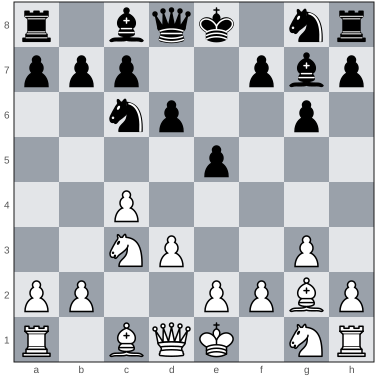
White to move. The pawn on c4 and the knight on c3 already watch d5. Add a pawn that attacks that square too.
A hint
The pawn on e2 has not moved yet, so it can go two squares.
Show the answer
6. e4
e4 is the Botvinnik System. The pawns on c4 and e4 and the knight on c3 all attack d5, so a black piece or pawn that steps onto d5 meets three attackers, and a white knight may land there later. The price is that the pawn on e4 now stands in the way of the bishop on g2. The engine counts e4 among the best moves here.
In numbers
How often it is played
| Rating | Value |
|---|---|
| Under 800 | 4.5 |
| 800 to 1199 | 14 |
| 1200 to 1599 | 19 |
| 1600 to 1999 | 29 |
| 2000 and up | 44 |
How the games ended
White won 51%, 5% were drawn and Black won 44%, over 46,078 games that start this way, in a sample of rated Lichess games from 2026.