Chess lessons › Chess openings
The Marshall Attack
Black gives a pawn in the Ruy Lopez for an attack; learn the idea, and how White avoids it with 8.a4 or 8.h3.
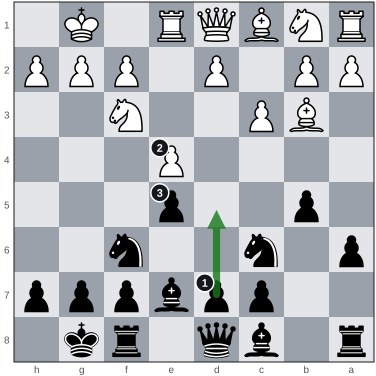
The idea
Black gives a pawn in the Closed Ruy Lopez for active play.
- Black answers c3 with ...d5, hitting the pawn on e4.
- White takes on d5 and Black takes back with the knight.
- Black lets the pawn on e5 go for speed and an attack.
In a game: In the Closed Ruy Lopez, after Re1 and Bb3, c3 allows it; a4 and h3 are quieter.
How the lesson begins
In the Closed Ruy Lopez, White plays 8.c3 to prepare d4. The quiet answer is 8...d6. The Marshall Attack is the sharp alternative, 8...d5, a pawn sacrifice. Frank Marshall played it against José Raúl Capablanca in New York in 1918, and the line took his name. Capablanca won that game, but the line stayed in use.
Watch the main line. Count the pawns at the end.
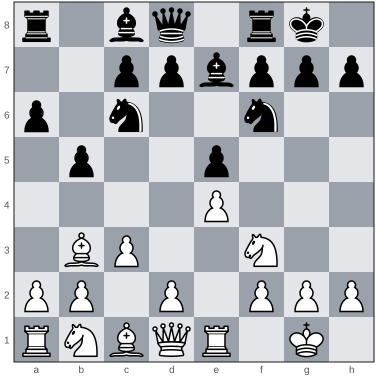
- 8... d5 Black strikes at the centre.
- 9. exd5 White takes the pawn.
- 9... Nxd5 Black takes back and leaves the pawn on e5 to the knight on f3.
- 10. Nxe5 White wins a pawn.
- 10... Nxe5 Black takes the knight.
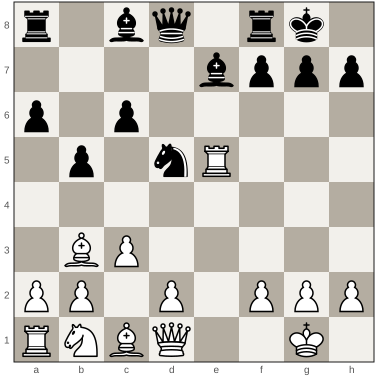
- 11. Rxe5 The rook takes back. White is a pawn up.
- 11... c6 The pawn on c6 adds a guard to the knight on d5, which the bishop on b3 attacks.
A question
White has an extra pawn here. Why does the engine still call the position level?
Show the answer
Black’s pieces are active and can swing to the kingside, while White’s knight on b1, bishop on c1 and rook on a1 are still at home.
Right. Black paid a pawn for speed. The rest of this lesson shows how Black uses it against White’s king.