Chess lessons › Chess openings
The Queen’s Indian Defence
Answer 3.Nf3 with ...b6, put the bishop on b7 or a6, and fight for the light squares.
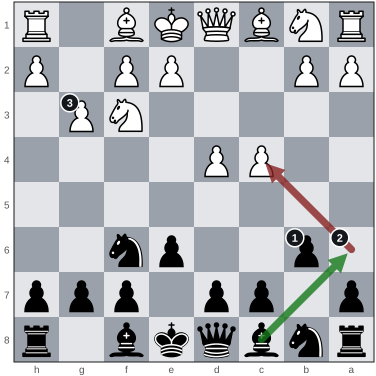
The idea
Black plays ...b6 and puts the bishop on b7 or a6.
- The pawn on b6 opens a road for the bishop on c8.
- From a6 the bishop hits the pawn on c4.
- White’s g3 makes room for a bishop on g2, on the long diagonal.
In a game: When 3.Nf3 rules out a pin, ...b6 lets your bishop fight for e4 or hit c4.
How the lesson begins
After 1.d4 Nf6 2.c4 e6, White can play 3.Nf3 instead of 3.Nc3. Then 3...Bb4 does not pin a knight, as it does in the Nimzo-Indian.
Black can answer 3...b6, the Queen’s Indian Defence, chosen in 23% of games after 3.Nf3 among players rated 2000 and above on Lichess. The bishop on c8 will come out on b7 or a6 to fight for the light squares, above all e4.
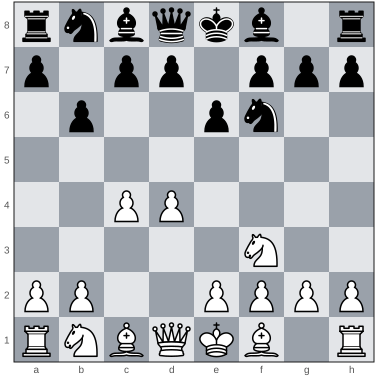
A question
Why do many players choose 3.Nf3 here rather than 3.Nc3?
Show the answer
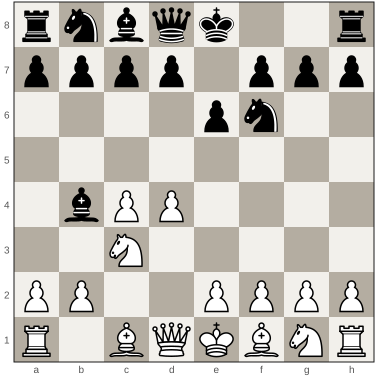
After 3.Nc3 Bb4 the bishop pins the knight on c3 to the king: the Nimzo-Indian. 3.Nf3 avoids it.
Right. Here is the Nimzo-Indian position: the knight on c3 cannot move without exposing the king. With the knight on f3 instead, there is nothing to pin.
In numbers
How often it is played
| Rating | Value |
|---|---|
| Under 800 | Too few games |
| 800 to 1199 | Too few games |
| 1200 to 1599 | Too few games |
| 1600 to 1999 | Too few games |
| 2000 and up | 0.5 |
How the games ended
White won 45%, 7% were drawn and Black won 48%, over 119 games that start this way, in a sample of rated Lichess games from 2026.