Chess lessons › Chess openings
The Taimanov and the Kan
After 2...e6, Black plays ...Nc6 or ...a6 and keeps the plan flexible, with the queen often on c7.
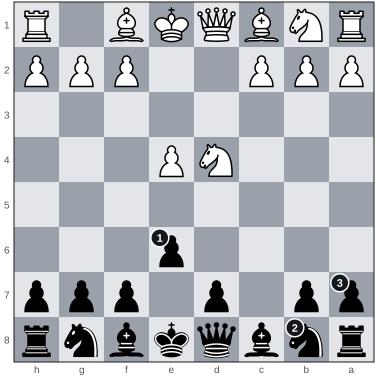
The idea
After 2...e6, Black plays ...Nc6 or ...a6 and keeps plans open.
- The pawn on e6 covers d5 and opens a path for the bishop on f8.
- The knight to c6 is the Taimanov.
- The pawn to a6 is the Kan, keeping White’s pieces off b5.
In a game: If a white knight can land on b5 and eye d6, have ...a6 or ...d6 ready.
How the lesson begins
After 1.e4 c5 2.Nf3 e6 3.d4 cxd4 4.Nxd4, Black has two flexible systems. 4...Nc6 is the Taimanov, and 4...a6 is the Kan. In both, the pawn on e6 covers d5, and Black waits to see where White’s pieces go.
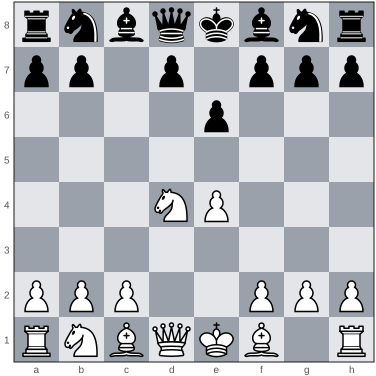
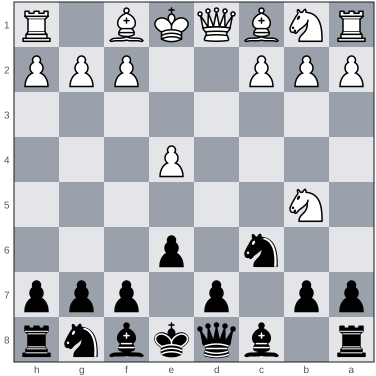
In the Taimanov, White can jump 5.Nb5. The knight eyes d6, where it would give check, and only the bishop on f8 guards that square.
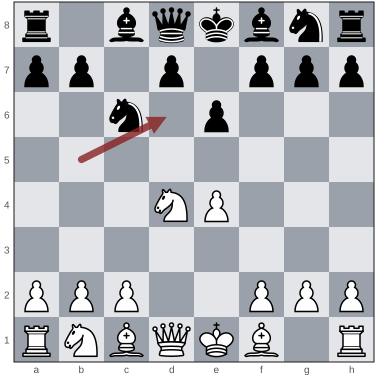
- 5. Nb5
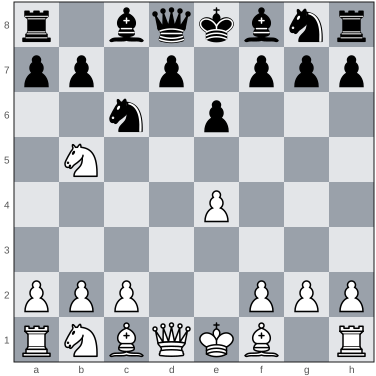
Find the move
Black to move. Stop the knight from landing on d6.
A hint
Put a pawn on the square.
Show the answer
5... d6
5...d6 takes the square away. Bobby Fischer against Tigran Petrosian, 1971, and Anatoly Karpov against Garry Kasparov, 1984, both went this way.
In numbers
How often it is played
| Rating | Value |
|---|---|
| Under 800 | Too few games |
| 800 to 1199 | Too few games |
| 1200 to 1599 | 1.6 |
| 1600 to 1999 | 5.1 |
| 2000 and up | 9.1 |
How the games ended
White won 47%, 5% were drawn and Black won 49%, over 6,530 games that start this way, in a sample of rated Lichess games from 2026.