Chess lessons › Chess strategy
The centre
Why the four middle squares matter, and two ways to fight for them.
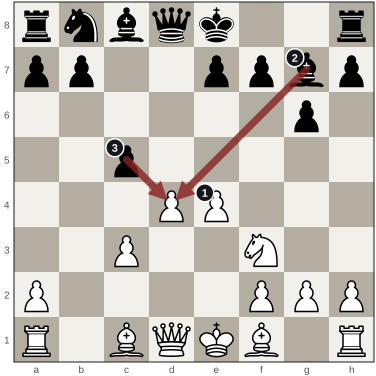
The idea
Control the middle squares, with pawns or with pieces aimed at them.
- White holds the centre with pawns: the classical way.
- Black’s bishop attacks d4 from afar: the hypermodern way.
- The pawn on c5 joins in, and White must keep d4 guarded.
In a game: In the opening, ask who controls d4, e4, d5 and e5, with pawns and with pieces.
The lesson
The four squares in the middle of the board, d4, e4, d5 and e5, are the centre. The player who controls them usually has more room to move. A piece in the centre can reach both wings quickly, and a pawn there takes squares away from the enemy pieces.
That is why almost every opening starts by fighting for the centre.

Compare two knights. The one on e4, in the centre, can jump to 8 squares. The one on h4, on the edge, can reach only 4. The same piece does much more work from the middle of the board.

Find the move
You are White, and it is the first move. Put a pawn in the centre.

A hint
Move the pawn from e2 or from d2 two squares forward.
Show the answer
1. d4
Both moves put a pawn on a centre square. A pawn on e4 attacks d5 and f5, and a pawn on d4 attacks c5 and e5, so enemy pieces cannot settle there easily. Both also open lines for your bishop and queen. This is the classical way to fight for the centre: occupy it with pawns.
Find the move
White has a pawn on e4, and Black has answered with a pawn on e5. Now bring out a knight so that it attacks Black’s centre pawn.
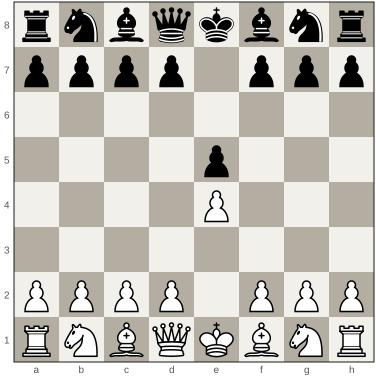
A hint
A knight on f3 attacks e5.
Show the answer
2. Nf3
Nf3 develops the knight and attacks the pawn on e5 at the same time. A developing move that makes a threat is one of the best ways to fight for the centre. It is also the first choice of the engine, the computer program that analyses chess positions.
A question
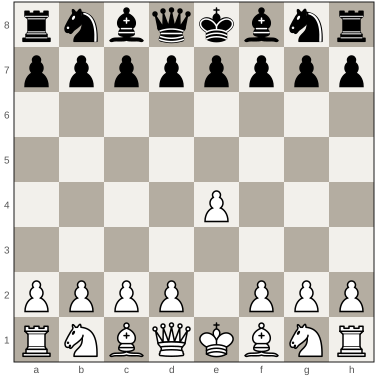
White has opened with 1.e4. Black to move. Which reply fights for the centre?
Show the answer
1...e5, a pawn to the centre.
Right. It puts a pawn on a centre square of its own and takes d4 and f4 away from White. The engine rates it among Black’s best replies.
There is a second way to fight for the centre, the opposite of the classical one. Black does not rush pawns into the middle. Black lets White build a big centre, then attacks it from the side with pieces and pawns. This is called the hypermodern idea.
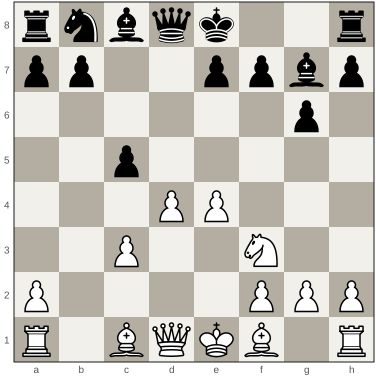
Step through the moves. White builds pawns on c3, d4 and e4, and Black strikes at them.
- 1. d4 White takes the centre with a pawn.
- 1... Nf6 Black answers with a knight, not a pawn.
- 2. c4 g6 Black is getting ready to put a bishop on g7.
- 3. Nc3 d5 A pawn challenges the centre for a moment.
- 4. cxd5 Nxd5 Black’s knight takes back and eyes the centre.
- 5. e4 White gets pawns on d4 and e4, and attacks the knight.
- 5... Nxc3 6. bxc3 White has pawns on c3, d4 and e4. Black has none in the middle.
- 6... Bg7 The bishop aims straight at d4.
- 7. Nf3 White guards d4.
- 7... c5 A pawn joins the bishop, so d4 is attacked twice.
A question
White has pawns on c3, d4 and e4, and Black has none in the middle. Is White clearly better?
Show the answer
No, the engine rates it about level, because Black attacks the centre.
Right. A big centre is a strength, but it has to be kept, and it makes a target. Black has real play against it, so the game is balanced.