Domination: trapping a piece in the open
Cover every square a piece can go to, then attack it: it has nowhere to escape.
The idea
Cover every square a piece can go to, and then attack it.
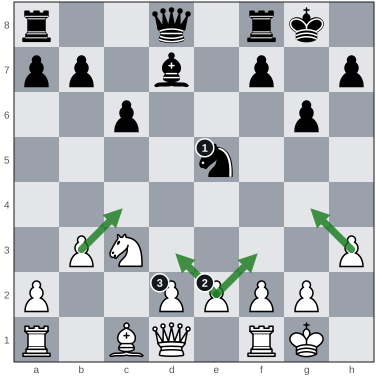
- The knight has four moves: c4, d3, f3 and g4.
- Pawns cover all four squares, so it cannot move safely.
- Then d4 attacks it, and a pawn takes it wherever it goes.
In a game: Before you attack a piece, list the squares it can go to and ask who covers each.
How the lesson begins
A piece is dominated when every square it could move to is covered. Nothing attacks it yet, but it cannot go anywhere without being taken. Then one quiet move that attacks it wins it.
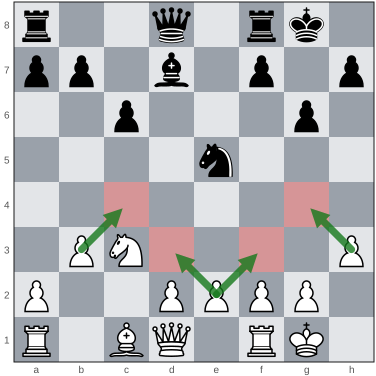
The black knight here has only four moves: c4, d3, f3 and g4. Black’s own pieces fill the other four squares it could jump to. White’s pawns already cover all four: b3 covers c4, e2 covers d3 and f3, and h3 covers g4.
Find the move
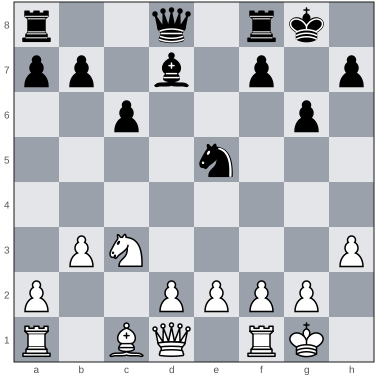
White to move. The knight is not attacked, and it has no safe square. Find a quiet pawn move that wins it.
A hint
A pawn attacks the knight from a square where nothing can stop it.
Show the answer
1. d4
d4 attacks the knight. It cannot go to c4, d3, f3 or g4, because a pawn takes it on every one of them. Defending it does not help either, because the pawn takes it anyway and Black has only a pawn back. f4 attacks it too and also wins it.
In numbers
In the puzzle bank
707 puzzles in GreyChess’s bank practise it. Half of them are rated between 1,219 and 2,304.
The piece that makes the first move of the answer: bishop 25%, rook 20%, pawn 16%, queen 14%, knight 14%, king 13%, in puzzles from the Lichess puzzle database.