Pawn forks
A pawn attacks two squares at once, so one pawn move can attack two pieces worth far more.
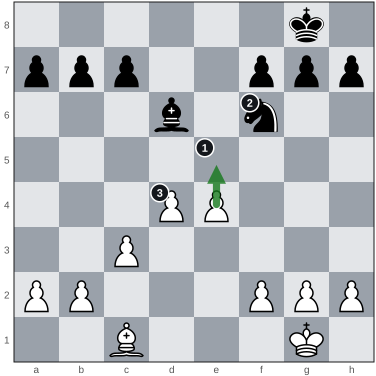
The idea
One pawn move attacks two pieces, each worth far more than the pawn.
- The pawn steps forward one square.
- Now it attacks both the bishop and the knight.
- The pawn on d4 defends it, so taking it costs a piece.
In a game: Look for two enemy pieces on one rank with a square between them, and a pawn that can attack both.
How the lesson begins
A pawn captures one square diagonally forward, so it attacks two squares at once. When two enemy pieces stand on those squares, one pawn move attacks both of them. This is a pawn fork. It hurts, because each piece is worth far more than the pawn.
Here Black’s bishop on d6 and knight on f6 stand on the same rank, with one square between them. Press Next move.
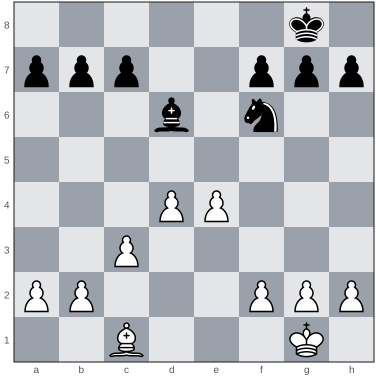
- 1. e5 The pawn attacks both pieces. The pawn on d4 defends it, so taking it would only lose the bishop for a pawn.
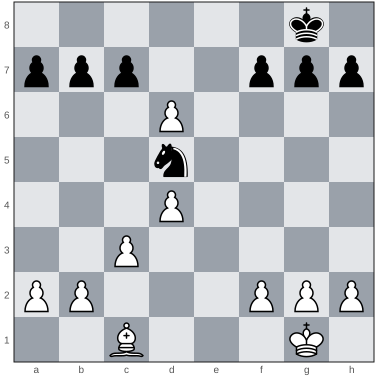
- 1... Nd5 Black saves the knight.
- 2. exd6 And the pawn takes the bishop.
Find the move
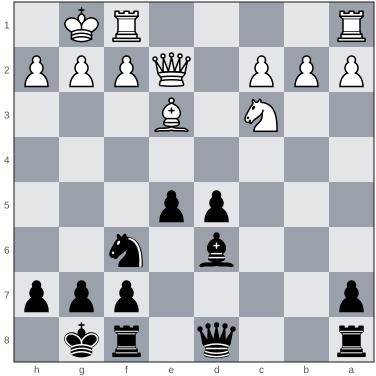
Black to move. White’s knight on c3 and bishop on e3 stand on the same rank, with one square between them. Find the pawn move that attacks both.
A hint
Push a centre pawn one square.
Show the answer
1... d4
d4 forks the knight and the bishop. The pawn on e5 defends it, so taking it does not help: after Bxd4 exd4 the new pawn on d4 attacks the knight. White loses a piece.