Zugzwang in the middlegame
With many pieces on the board, a side can still run out of moves that do not lose something.
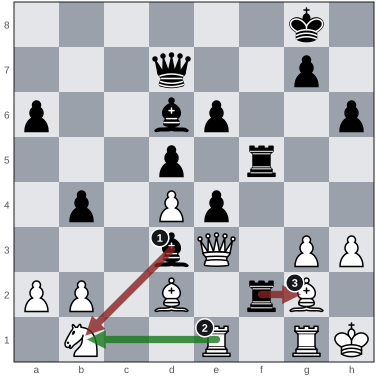
The idea
Every move makes things worse, so the side to move would rather pass.
- The bishop on d3 attacks the knight on b1.
- Only the rook on e1 guards that knight.
- Even White’s best move leaves Black over four pawns ahead.
In a game: When your opponent’s pieces all guard each other, make a quiet move and let them run out of moves.
How the lesson begins
Zugzwang is a German word for a position where the player to move would like to pass, because every move makes things worse. It is common in endings. In the middlegame it is rare, because there is nearly always a harmless move to make.
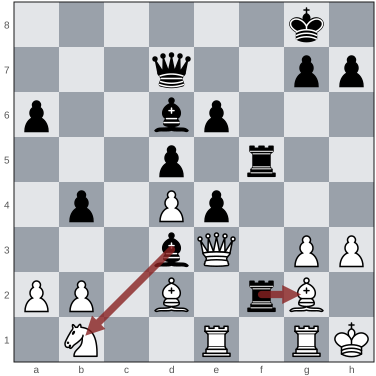
This is a famous example: Friedrich Sämisch against Aron Nimzowitsch, Copenhagen 1923, often called the Immortal Zugzwang Game. Black is a knight down for two pawns, but Black’s rooks and bishops are active. The rook on f2 attacks the bishop on g2, and the bishop on d3 attacks the knight on b1.
Find the move
Black to move. Black has no need to attack anything more. Find a quiet pawn move that costs nothing and hands the move to White.
A hint
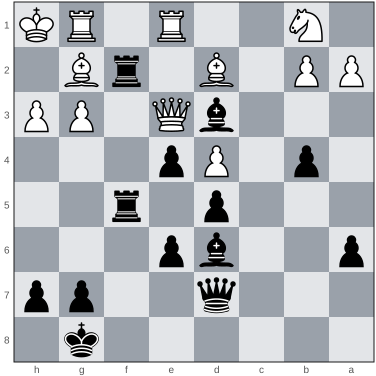
Move a pawn on the edge of the board.
Show the answer
25... h6
h6 was Nimzowitsch’s move in the game, and it gives the king a square on h7. a5 would also do. Black can afford to wait, and now White has to move.
In numbers
In the puzzle bank
795 puzzles in GreyChess’s bank practise it. Half of them are rated between 1,187 and 2,420.
The piece that makes the first move of the answer: king 57%, pawn 32%, rook 5%, bishop 3%, knight 2%, queen 1%, in puzzles from the Lichess puzzle database.