Chess lessons › Good chess habits
Annotating your own games
Write your own notes first, with the usual symbols and a few words, then check them with an engine.
The idea
Write your own notes first, then check them with an engine.
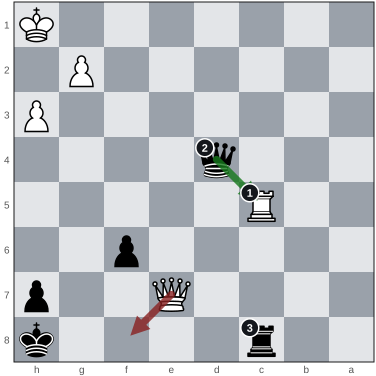
- The rook on c5 is attacked twice and defended once.
- Qxc5 wins it, and the rook on c8 still guards f8.
- Rxc5?? left the back rank, and Qf8 mated: note why.
In a game: After each game, mark the move where the result changed, and write why and what was better.
How the lesson begins
Annotating a game means writing notes on its moves: symbols, and a few words where they help. The best time is soon after the game, while you still remember what you were thinking.
Work in two passes. First, without an engine, write down your thoughts at the key moments: the moves you considered, what you were afraid of, and where you spent a lot of time. Then check with an engine, and note where your thinking went wrong. The first pass is what teaches you; the engine only marks it.

A question
Notes use a small set of symbols for moves. Which one marks a blunder, a move that throws the game away?
Show the answer
??.
Right. The six move symbols are !! (brilliant), ! (good), !? (interesting), ?! (dubious), ? (mistake) and ?? (blunder).