Chess lessons › Good chess habits
Ruling out moves
Cross a candidate off once you find one good reply to it, and spend your time on the moves left.
The idea
Cross a move off your list once you find one good reply to it.
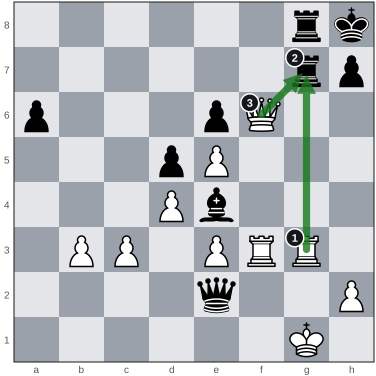
- Rxg7 fails to one reply, Rxg7+, and then Black is winning.
- One good reply is enough: cross Rxg7 off and stop there.
- Qxg7+ is left, and it mates: Rxg7, Rf8+ Rg8, Rgxg8#.
In a game: For each candidate, look for your opponent’s best reply first; if it holds, drop the move.
How the lesson begins
Your list of candidate moves may be long, and you cannot calculate every one to the end. You do not need to. A candidate is ruled out as soon as you find one good reply for your opponent. Cross it off, and spend your time on the moves that are left.
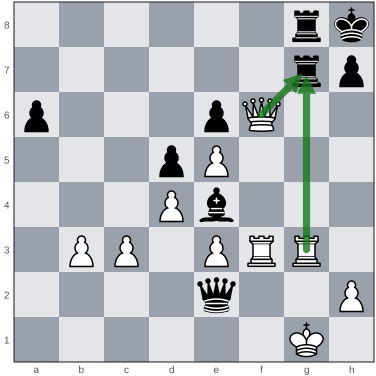
This is Frank Marshall against Karel Treybal, Hamburg Olympiad 1930. White to move. Two rooks on the g-file are pinned: Black’s on g7 by your queen, and yours on g3 by Black’s rooks. Two captures on g7 look tempting: Rxg7 and Qxg7+.
Find the move
Start with Rxg7, the capture that keeps your queen. Suppose White plays it. Now you are Black: find the reply that rules it out.
A hint
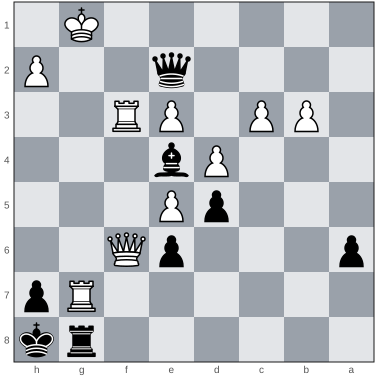
With the rook gone from g3, look down the g-file at White’s king.
Show the answer
50... Rxg7+
Rxg7+. Black takes back with check: the rook on g3 had been shielding White’s king from the rooks on the g-file. White’s attack is gone, and Black is winning. One good reply is enough: Rxg7 is crossed off.