Chess lessons › Good chess habits
Comparing two lines
When two moves look good, follow each to its end, judge both end positions, and only then choose.
The idea
Follow each good move to its end, then pick the better end.
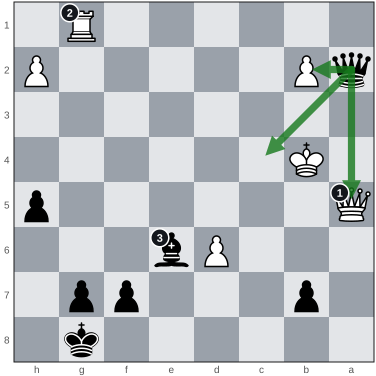
- Qxa5+ trades queens, into an ending that White wins.
- Qxb2+ chases the king, then wins the rook on g1.
- Qc4+, guarded by the bishop, leaves only Ka3, and Qb3 mates.
In a game: When two moves both look good, play neither until you have judged where each one ends.
How the lesson begins
Often you have two or three good candidate moves, and each has its own tree. Do not play the first one that seems to work. Follow each to a quiet end, judge the end positions side by side, and then choose.
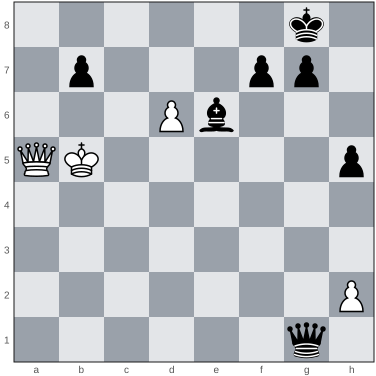
This is Johann Löwenthal against Henry Thomas Buckle, London 1851. Black to move. White has a rook against a bishop and a pawn, and a passed pawn on d6. Black has three tempting queen checks: Qxa5+, Qxb2+ and Qc4+.
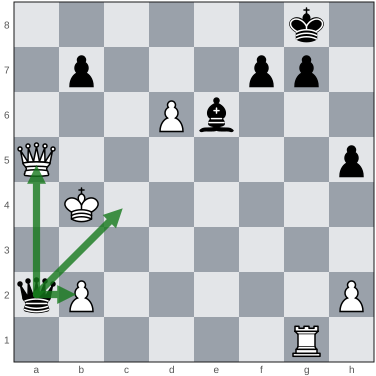
Line one: Qxa5+ trades queens with check. Under pressure a trade feels safe, but judge the end. After Kxa5 White has a rook against a bishop, and the pawn on d6 is still passed. The engine rates this ending as winning for White.
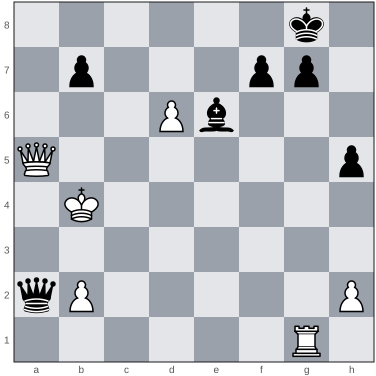
- 40... Qxa5+ 41. Kxa5 The queens are off. White has a rook, Black a bishop.
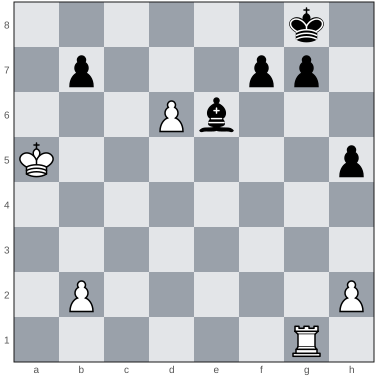
Line two: Qxb2+ is what Buckle played. The queen checks twice, then takes the rook on g1. Löwenthal resigned here. A good line: Black is winning at the end of it.
- 40... Qxb2+ 41. Kc5 Qf2+ Another check.
- 42. Kb5 Qxg1 The queen takes the rook.
Find the move
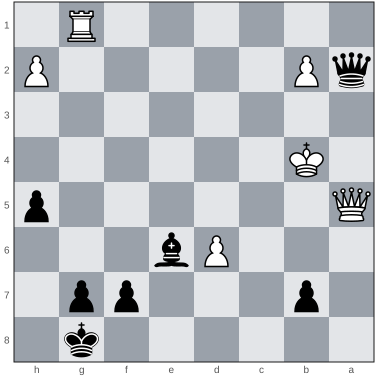
Line three is Qc4+. Calculate it before you judge it: where can the white king go? Black to move and mate in two.
A hint
Check on c4, where the bishop protects the queen. Then count the king’s squares.
Show the answer
40... Qc4+ 41. Ka3 Qb3#
Qc4+. The bishop on e6 protects the queen, so the king cannot take her, and Ka3 is White’s only move. Then Qb3#, again protected by the bishop. Of the three lines, this one ends the game at once.