Chess lessons › Good chess habits
The tree of variations
A calculation branches at every reply: list them all, then go through each branch once.
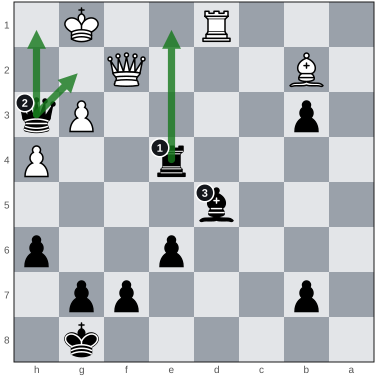
The idea
List every reply to your move, then answer each branch once.
- Re1+ is the trunk: White can answer Rxe1, Qxe1 or Qf1.
- Each branch needs its own mate: Qh1 after Rxe1, Qg2 after Qxe1.
- Once the rook leaves e4, the bishop guards h1 and g2.
In a game: Before you play a check or a capture, count your opponent’s replies and answer each one.
How the lesson begins
A line is one path of moves: you play this, your opponent plays that. But at every turn your opponent has a choice, so a calculation is really a tree. Your candidate move is the trunk, and each reply your opponent could make is a branch. You need an answer to every branch, not only to the reply you expect.
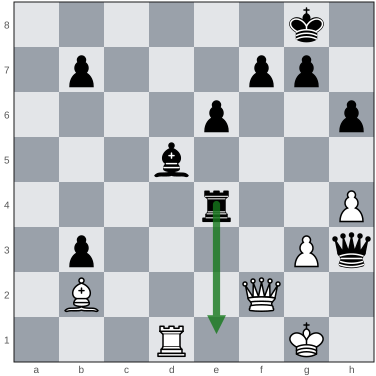
This is Hans Fahrni against Aaron Nimzovich, Karlsbad 1911. Black to move. Black has a strong candidate: the check Re1+.
A question
Black has played Re1+. Before you calculate any further, list White’s replies. How many legal moves does White have?
Show the answer
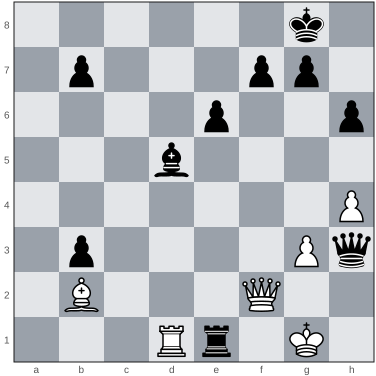
Three: Rxe1, Qxe1 and Qf1.
Right. The king has no square: the queen on h3 covers g2, h2 and h1, and the rook covers f1. So White must take the rook, with the rook or the queen, or block on f1. That is three branches.
In numbers
Blunders in real games
| Rating | Value |
|---|---|
| Under 800 | 6.6 |
| 800 to 1199 | 4.2 |
| 1200 to 1599 | 2.8 |
| 1600 to 1999 | 2 |
| 2000 and up | 1.3 |