Chess lessons › Good chess habits
Is my piece safe there?
Before a piece moves, look at every enemy piece that could take it on its new square.
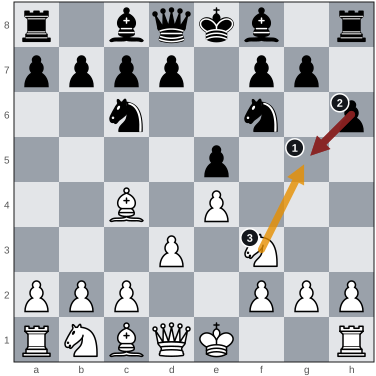
The idea
Before a piece moves, ask what could take it on its new square.
- The knight would like to jump here and attack a pawn next to Black’s king.
- But this pawn covers that square, so the knight would simply be taken.
- So look at the new square first, and choose one no enemy piece covers.
In a game: Before each move, look at the new square and ask which enemy piece could take your piece there.
The lesson
Before you move a piece, look at the square it is going to and ask: which enemy piece could take it there? Check every one. Start with the pawns and the knights, because they are the easiest to miss. Then look along the lines of the bishops, rooks and queen.
Here White would like to play Ng5 and attack the pawn on f7. But look at g5 first: the pawn on h6 covers it.
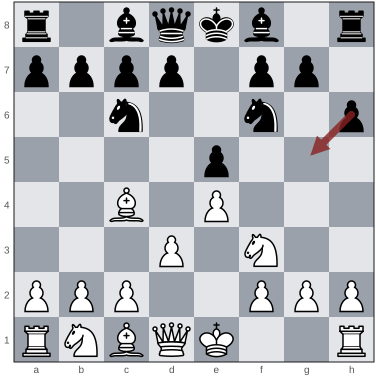
- 5. Ng5 The knight attacks f7, but it stands on a square a pawn covers.
- 5... hxg5 The pawn takes it, and White has lost a knight.
Find the move
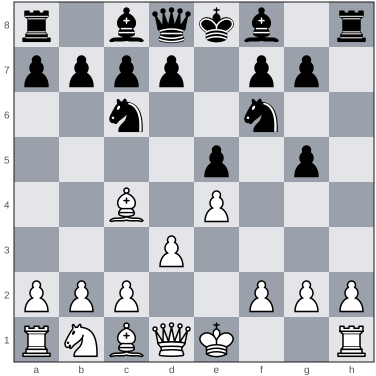
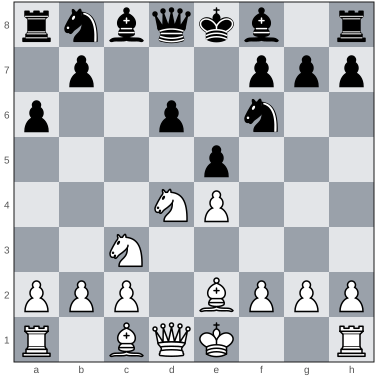
Black has just played 6...e5, and the pawn attacks your knight on d4. It has to move. Look at each square it can go to, ask what could take it there, and move it to a safe square.
A hint
Pawns guard the squares diagonally in front of them. Start with b5 and c6.
Show the answer
7. Nb3
Nb3 and Nf3 are both safe. The other squares are covered: the pawn on a6 guards b5, the pawn on b7 guards c6, the bishop on c8 guards f5, and the bishop and the pawn on f7 both guard e6.
Find the move
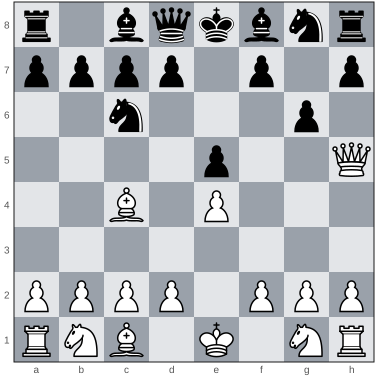
Black has just played 3...g6, and the pawn attacks your queen. She has many squares. Find one where no black piece can take her, and from which she still attacks f7.
A hint
The black queen reaches further than you think. Look along her diagonal before you choose.
Show the answer
4. Qf3
Qf3 is safe, and the queen and the bishop both aim at f7 again. Many other squares lose the queen: the pawn on g6 covers f5, the knight and the bishop cover h6, and the black queen on d8 reaches g5 and h4 along her diagonal.
A question
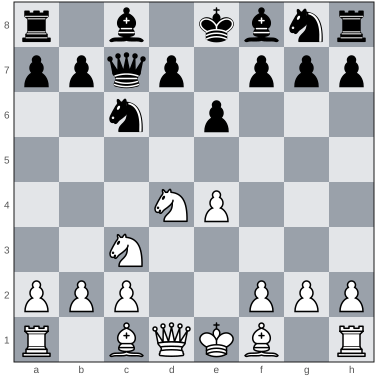
Several white knight moves attack the black queen on c7. Which of these puts the knight on a safe square?
Show the answer
Ndb5.
Right. No black pawn or piece covers b5, so the queen has to move and the knight stays where it is.
Practise
Now some on your own. In each one, your opponent has left a piece undefended. Find the way to win it.
In the lesson, 5 rated puzzles on this theme come from the puzzle bank, chosen near your rating.
In numbers
In the puzzle bank
1,185 puzzles in GreyChess’s bank practise it. Half of them are rated between 648 and 2,006.
The piece that makes the first move of the answer: queen 41%, rook 24%, king 11%, knight 10%, bishop 9%, pawn 5%, in puzzles from the Lichess puzzle database.
Blunders in real games
| Rating | Value |
|---|---|
| Under 800 | 6.6 |
| 800 to 1199 | 4.2 |
| 1200 to 1599 | 2.8 |
| 1600 to 1999 | 2 |
| 2000 and up | 1.3 |