Chess lessons › Good chess habits
What is my opponent threatening?
After every move, ask what it attacks and what it prepares.
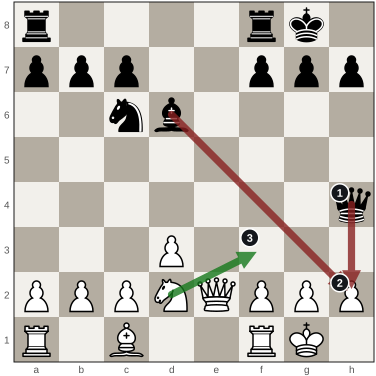
The idea
After every enemy move, ask what it attacks and what it prepares.
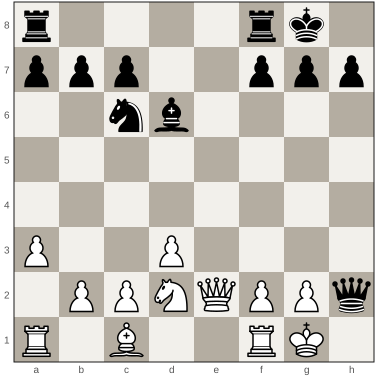
- Black’s queen and bishop both aim at the pawn next to your king.
- Only the king guards it, so the queen threatens to take it with mate.
- A knight here guards that pawn and attacks the queen as well.
In a game: After each enemy move, ask what it attacks, even when it is not a check or a capture.
The lesson
After every move your opponent makes, stop and ask: what does it do? A move can attack a piece, uncover an attack, threaten mate, or defend something. Do not look only at captures and checks.
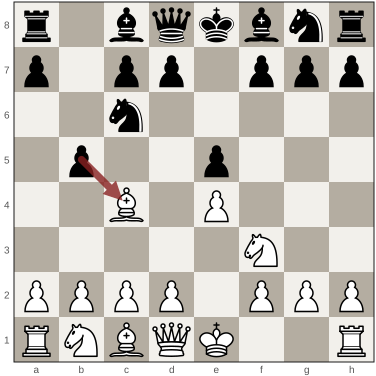
Black has just played 3...b5. Look at the pawn. What does it attack?
A question
What does the pawn move 3...b5 do?
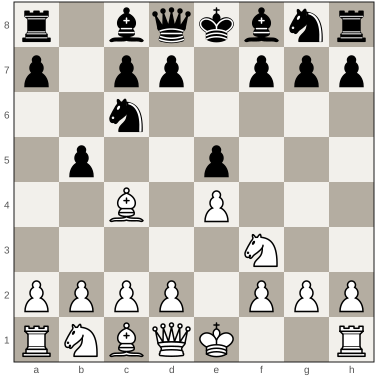
Show the answer
It attacks my bishop on c4.
Right. A pawn attacks the two squares diagonally in front of it, and c4 is one of them.
Find the move
Your bishop is attacked by a pawn. Before you move it away, ask: can you take the pawn?
A hint
Look at whether anything protects the pawn.
Show the answer
4. Bxb5
Bxb5 takes the pawn, and nothing protects it. When a piece of yours is attacked, ask whether you can take the attacker instead of running away.
Now a threat that is much more serious. Black’s queen and bishop both aim at the pawn on h2, and only the king defends it. If White ignores that and carries on with its own plans, this is what happens.
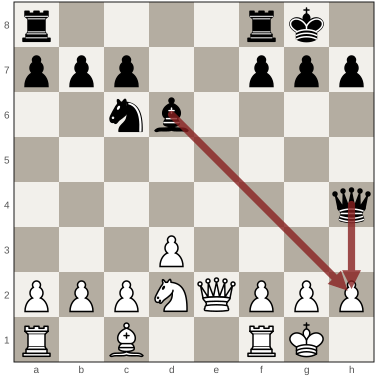
- 1. a3 White carries on with a plan of its own.
- 1... Qxh2# Checkmate. The bishop protects the queen, so the king cannot take her.
Find the move
Black threatens mate on h2. White to move. Find the move that stops it and attacks the queen as well.
A hint
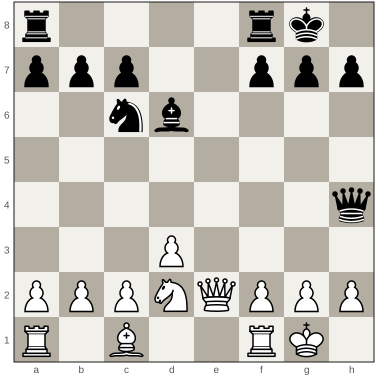
A knight can cover h2 and attack the queen in one move.
Show the answer
1. Nf3
Nf3 attacks the queen and covers h2 at the same time, so the mate is gone. The best defence often makes a threat of its own.
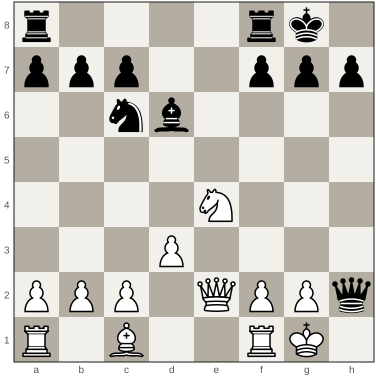
A move that does not deal with the threat is no defence. White might play Ne4, which attacks the bishop on d6. But Black simply takes on h2, because the bishop still protects the queen. Check that your move really stops what your opponent wants to do.
- 1. Ne4 It attacks the bishop, but it does not deal with the threat.
- 1... Qxh2# Checkmate. The bishop on d6 still protects the queen.
A question
Black’s last move did not capture and did not give check. Why should you still look at it?
Show the answer
A quiet move can attack a piece, uncover an attack or prepare a mate.
Right. Quiet moves are where many threats hide, because they do not announce themselves.
Practise
Now some on your own. Start each one by asking what your opponent threatens.
In the lesson, 5 rated puzzles on this theme come from the puzzle bank, chosen near your rating.
In numbers
In the puzzle bank
2,157 puzzles in GreyChess’s bank practise it. Half of them are rated between 1,750 and 2,712.
The piece that makes the first move of the answer: king 31%, pawn 28%, rook 15%, queen 13%, bishop 8%, knight 6%, in puzzles from the Lichess puzzle database.
Blunders in real games
| Rating | Value |
|---|---|
| Under 800 | 6.6 |
| 800 to 1199 | 4.2 |
| 1200 to 1599 | 2.8 |
| 1600 to 1999 | 2 |
| 2000 and up | 1.3 |