Chess lessons › Chess openings
How to study an opening
Learn why each move is played, the pawn structure it leads to, and master games in it, not a list of moves.
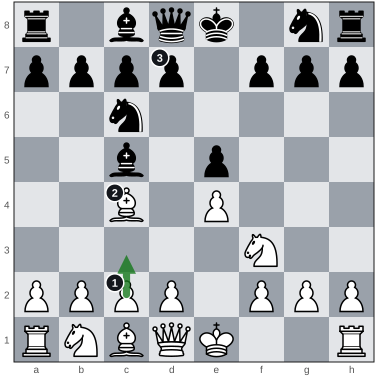
The idea
Learn why each move is played, the structure, and master games in it.
- Ask what each move is for: c3 is played to support d4.
- Bc4 aims at f7, which only Black’s king protects.
- Play through master games to see which ideas come back, like ...d5.
In a game: When the moves you learned run out, ask what your last move was for.
How the lesson begins
To study an opening, learn the reason for each move, not only the move. Then you can find your way when your opponent does something different. Step through the Giuoco Piano, an old line of the Italian Game, and read why each move is played.

- 1. e4 A pawn in the centre, and the bishop and queen can come out.
- 1... e5 2. Nf3 The knight develops and attacks the pawn on e5.
- 2... Nc6 The knight develops and protects the pawn on e5.
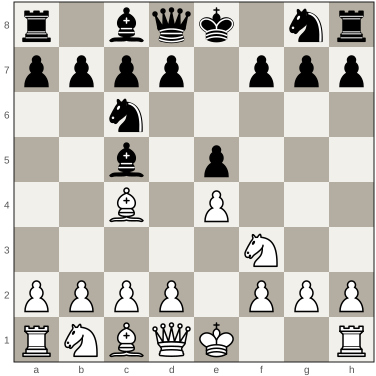
- 3. Bc4 The bishop aims at f7, which only Black’s king protects.
- 3... Bc5 Black’s bishop aims at f2 in the same way.
Find the move
White would like a second pawn in the centre with d4. Pushed now, it would be taken: the pawn on e5, the knight on c6 and the bishop on c5 all attack d4. White to move: prepare d4.
A hint
Which pawn can support d4?
Show the answer
4. c3
4.c3, the Classical Variation. The pawn on c3 covers d4, so next White can play d4 and, after a capture, take back with the c-pawn.