Chess lessons › Chess strategy
Bringing a piece to its best square
Choose the square first, then the route: a knight may take three moves to get there and stay almost forty.
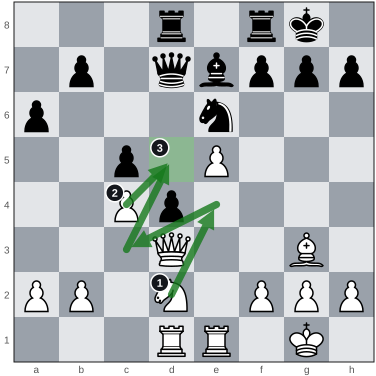
The idea
Choose the best square for a piece first, then find the road there.
- The knight on d2 has little to do.
- The pawn on c4 guards d5, and no black pawn can attack it.
- By e4 and c3 the knight reaches d5, and stays there almost forty moves.
In a game: Find your worst piece, pick the square it wants, then count the moves to get there.
How the lesson begins
A manoeuvre is a series of quiet moves that takes a piece to a better square. First decide where the piece belongs, then find the road there.
This is Carl Schlechter against Hugo Süchting, Vienna 1908. White’s knight on b1 has not moved yet, and c3 is taken by White’s own pawn. Watch the road Schlechter chose.
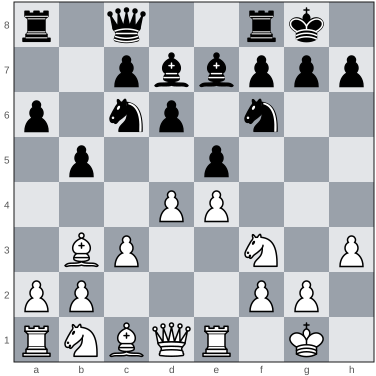
- 11. Nbd2 First to d2.
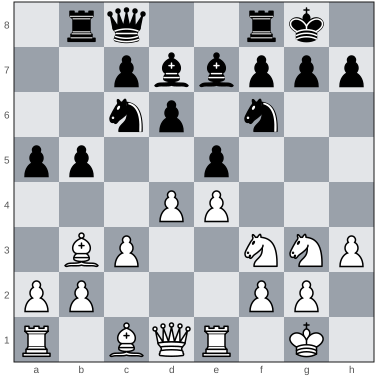
- 11... Rb8 12. Nf1 Then f1, free now that the rook has gone to e1.
- 12... a5 13. Ng3 And g3: three moves in all. From g3 the knight eyes f5 and h5, near Black’s king.
A question
Why did the knight not go to c3 or a3?
Show the answer
c3 holds White’s own pawn, and on a3 the knight stands on the edge with few squares.
Right. So the knight takes the longer road, d2, f1 and g3, to a square that matters.