Chess lessons › Chess strategy
Active and passive pieces
A piece is worth what it can do: count the squares it reaches, and free the ones that reach few.
The idea
A piece is worth what it can do: count the squares it reaches.
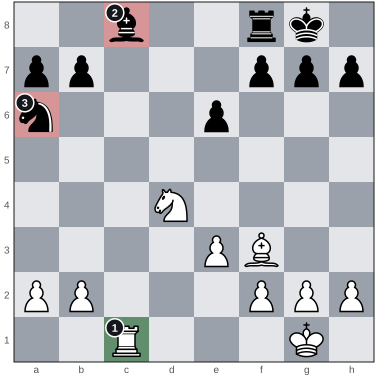
- White’s rook stands on the open c-file and reaches many squares.
- Black’s bishop on c8 is shut in by its own pawns.
- Black’s knight on a6 is on the edge, where it reaches few squares.
In a game: When nothing is happening, count how many squares each of your pieces reaches.
The lesson
Every piece has a value in points, but in a game a piece is only as good as the squares it can reach. A piece that reaches many useful squares is active. One that reaches few is passive.
Count White’s pieces here. The rook on the open c-file can go to 12 squares, the bishop on f3 to 8, and the knight on d4 to 7. The engine, the computer program that analyses positions, rates White as clearly better, although the material is level.
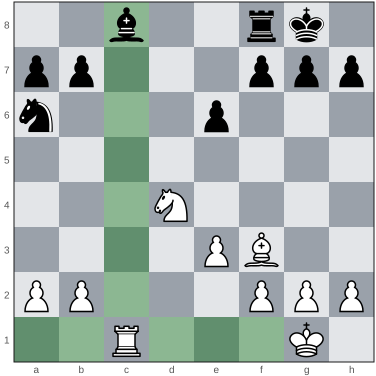
Now count Black’s pieces, as if it were Black’s move. The bishop on c8 has 1 square, because Black’s own pawns on b7 and e6 block it. The rook on f8 has 2: it stands behind its own pawn on f7. The knight on a6 has 4, because a knight on the edge of the board reaches fewer squares than one in the middle.
The material is the same, but Black’s pieces do much less. That is why White is better.
Find the move
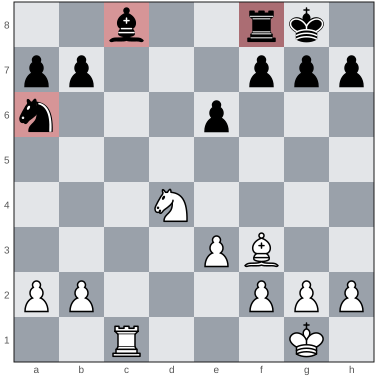
White’s knight stands on the edge of the board, on a4, where it can go to only 3 squares, and Black’s bishop on e8 attacks it. White to move. Put the knight on a square nearer the middle, where it does more.
A hint
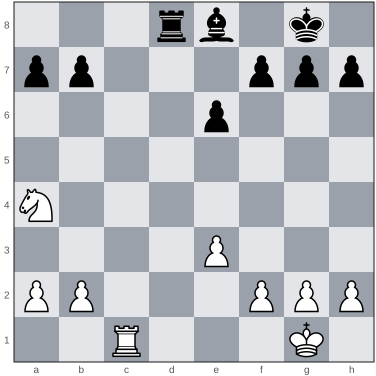
The knight can jump from a4 to c5.
Show the answer
1. Nc5
Nc5 puts the knight on a strong square near the middle of the board, where it attacks the pawns on b7 and e6. It is the engine’s first choice. A knight on the edge reaches at most four squares; in the middle it reaches up to eight.
A question
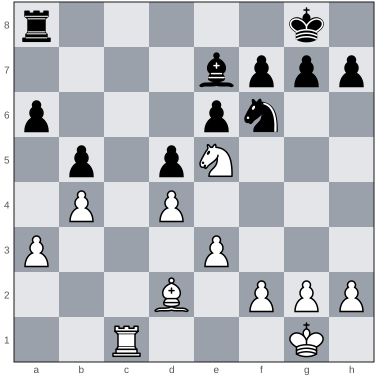
Count the squares each White piece can go to. Which is White’s most passive piece?
Show the answer
The bishop on d2.
Right. It can go to only 2 squares. White’s pawns on a3, b4, d4 and e3 stand on dark squares, the colour this bishop moves on, and the ones on b4 and e3 block its diagonals. A bishop hemmed in by its own pawns is called a bad bishop.
Find the move
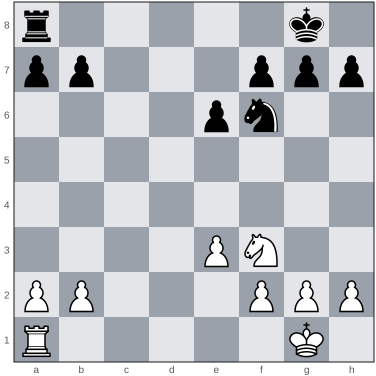
White’s rook on a1 can go to only 5 squares, all of them on the back rank, because the pawn on a2 shuts the a-file. Neither side has a pawn on the c-file or the d-file. White to move. Put the rook where it does more.
A hint
Which files have no pawns on them at all?
Show the answer
1. Rc1
Rc1 puts the rook on the open c-file. From there it controls the whole file, all the way to c8 in Black’s half of the board. It is the engine’s first choice. A rook belongs on an open file, where no pawn blocks it.
A question
You have found your most passive piece. What do you usually do with it?
Show the answer
Bring it to a square where it reaches more: a knight towards the middle, a rook to an open file.
Right. When there is no tactic on the board, improving your most passive piece is one of the best things you can do.