Chess lessons › Chess strategy
The Hedgehog
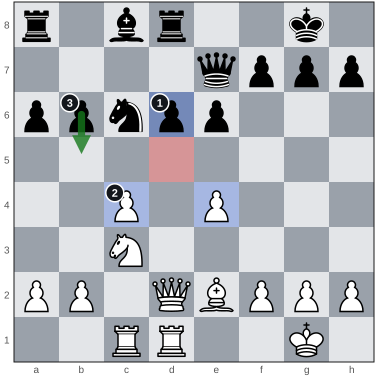
Black waits behind pawns on a6 b6 d6 e6 and breaks out when White overreaches.
The idea
Black waits behind pawns on a6 b6 d6 e6 and breaks out later.
- Black’s pawns on a6, b6, d6 and e6 leave White the space.
- White’s pawns on c4 and e4 both watch d5.
- Black waits, then breaks with ...b5 when White overreaches.
In a game: If you have pawns on a6, b6, d6 and e6 against c4 and e4, wait and look for ...b5 or ...d5.
How the lesson begins
This is the Hedgehog, from a game between Garry Kasparov (White) and Vladimir Kramnik (Black) in 1998. Black’s pawns stand on a6, b6, d6 and e6, all on the sixth rank, and the pieces stay close behind them. White’s pawns on c4 and e4 take the space in front.
Black is cramped, and the engine rates White as better. The d-file is half-open for White, so the pawn on d6 is the one Black has to keep guarded. The Hedgehog player does not hurry. Black waits, keeps the pieces flexible, and strikes with a pawn break when White’s pieces stand in the wrong places.
A question
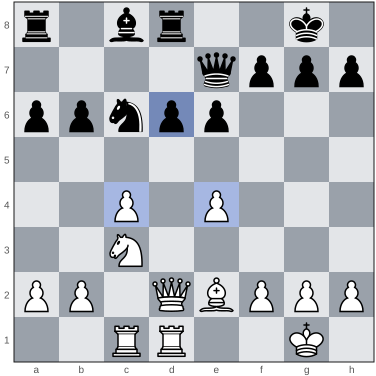
What do White’s pawns on c4 and e4 do to the square d5?
Show the answer
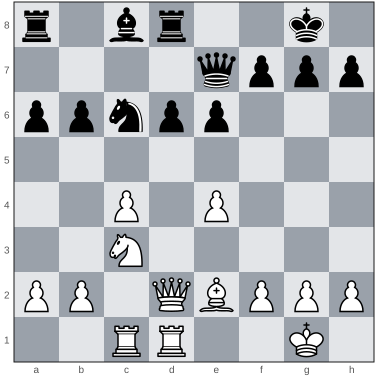
Both attack it, so Black cannot push ...d5 without plenty of support.
Right. A White pawn captures forwards and sideways, so the pawn on c4 attacks b5 and d5, and the pawn on e4 attacks d5 and f5. That is why the break ...d5 has to be prepared.