Attacking f7 and f2
The king alone guards f7 and f2 at the start, which makes them early targets.
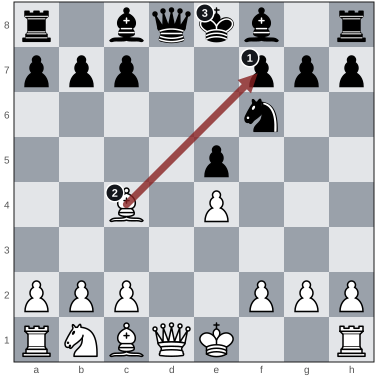
The idea
Only the king guards f7 and f2 at first, inviting early attacks.
- Only Black’s king guards the pawn on f7.
- White’s bishop on c4 aims straight at it.
- Bxf7+ wins the pawn with check, and the king can no longer castle.
In a game: Look for an uncastled king that alone guards f7 or f2, and a piece that can strike there.
How the lesson begins
At the start of a game, f7 is Black’s weakest square and f2 is White’s. Each is guarded only by the king, and a king is a poor guard: it cannot take a piece that is protected, and an attack there often comes with check.

This position can arise after 1.e4 e5 2.Nf3 d6 3.Bc4 Nc6 4.d4 Nf6 5.dxe5 Nxe5 6.Nxe5 dxe5. Black’s king is still on e8, f7 is guarded only by the king, and White’s bishop on c4 aims at it.
Notice too that the queens face each other on the open d-file, and Black’s queen on d8 is also guarded only by the king.
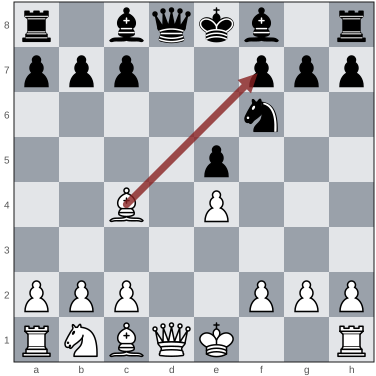
Find the move
White to move. Find the move that strikes on f7.
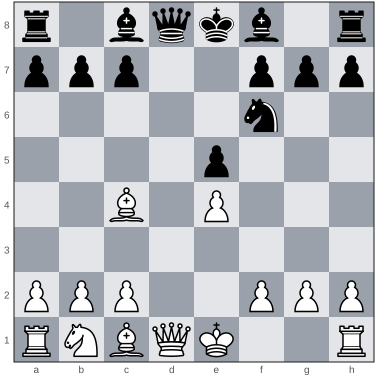
A hint
f7 is guarded only by the king. Take it with check.
Show the answer
7. Bxf7+
Bxf7+ takes the pawn with check. The king is the only piece that guards f7, and it also guards the queen on d8. If Kxf7, the queen loses her guard and Qxd8 takes her. The engine rates Bxf7+ far above every other move.
In numbers
In the puzzle bank
774 puzzles in GreyChess’s bank practise it. Half of them are rated between 960 and 2,181.
The piece that makes the first move of the answer: queen 41%, bishop 36%, knight 13%, rook 5%, pawn 5%, in puzzles from the Lichess puzzle database.